

Author: jonnarcross
By Emily Wegener, Senior Policy Officer, Transparency International Defence & Security
Last Wednesday, Russia’s full-scale invasion of Ukraine entered its fifth year. Over the past four years, Europe has been forced to confront the reality that war on its continent is not a thing of the past, and that it cannot rely on others to provide for its security. At Chatham House’s annual Security and Defence Conference last week, the mood reflected a sector entering a new era: technical and financial changes are beginning to bear fruit, and the mourning period for pre-2022 assumptions is over.
But one concern loomed largely in the room: public support. Leaders are waking up to the fact that record levels of defence spending is arriving at the worst possible time for public trust in institutions. Across OECD countries, a higher share of people (44%) report low to no trust in their national governments than moderate to high trust (39%). The question is no longer just whether the public understands the threat. It is whether the public trusts governments to respond to it competently.
This is a crucial distinction. Much of the discussion at Chatham House focused on better communicating the severity of the threats Europe faces. That matters. But it misses a deeper problem. The evidence suggests the public is not suffering from a knowledge gap – it is suffering from a trust gap. And that demands a fundamentally different response.
Support is broad but shallow – and already declining
Opinion polls from the last six months offer European leaders some comfort: majorities across the EU and also in the UK support defence spending increases. But the picture is more fragile than it first appears. Support levels are already declining from their post-invasion peak. When broken down by degree, only around one-third of respondents back strong spending increases- and there are sharp regional variations (see figure 1), closely tied to how directly different populations perceive the threat from Russia (see figure 2).
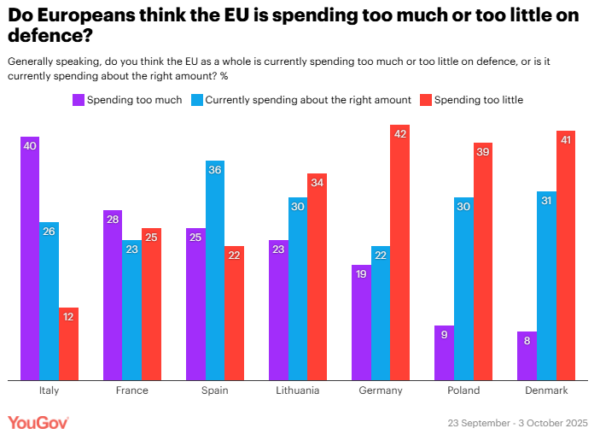
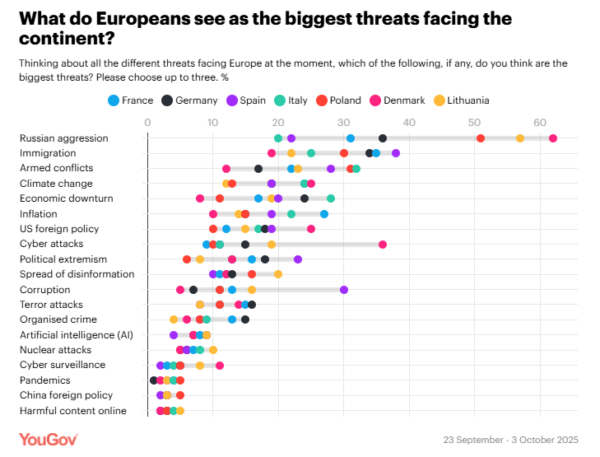
With support levels already past their peak, it is the future of public buy-in that leaders at Chatham House rightly expressed great concern about. Trade-offs between military and social spending – which, in time of tight budgets, seem inevitable if NATO’s 5% spending commitment is to become reality – are unsurprisingly unpopular: for example, polling from the UK shows that only 29% would support cuts in social security spending to fund military spending, and only 34% cuts on climate action.
The (risky) promise of growth will not fix the trust gap
Many leaders are trying to soften these trade-offs by positioning defence spending as catalyst for economic growth. The problem is that the evidence does not support this. Defence ranks among the least effective forms of government expenditure for driving economic growth. And the public knows that: a large majority of European citizens do not expect to benefit from higher defence spending – a scepticism that increases with financial literacy.
The problem is not a knowledge gap. The problem is that the argument does not hold and could become a risky gamble with an already feeble public trust. Leaders would be better served by honesty about costs and a credible case for responsible governance.
Democracy is not dead – but voters wish for better governance
The roots of the trust deficit run deep. Across and beyond Europe, citizens are increasingly less confident in their institutions and highly dissatisfied with how democracies are working. Amongst headlines such as “1 in 5 Europeans say dictatorship might be preferable”, how does this impact support for defence spending?
Corruption is perceived by many Europeans as one of the biggest threats to the continent – ranking above terror attacks (see figure 2) – and its democracies. Countries that are more worried about corruption and lacking accountability in politics, such as Spain, Italy, and France, also often rank amongst those more sceptical towards defence spending increases. Of course, factors such as geographical proximity to Russia and history of Russian occupation are likely to be stronger determinants in shaping these views.
But if governments want citizens to support them in significant investment in a sector that is notoriously remote and secretive, they will need to have confidence that institutions will use these resources effectively and responsibly. Evidence shows that the inability of governments to respond to recent crises, such as the corruption-fraught pandemic response and the cost-of-living crisis, have contributed greatly to recent declines in trust.
A problem and an opportunity
Citizens want their states to do better. Strengthening transparency, anti-corruption and accountability is a prime way to restore trust. A recent IPSOS study across eight European countries and the US found that “[s]trong desire for radical change coexists with continuing support for democratic principles”. Stronger anti-corruption laws and enforcement were seen as the most effective out of all potential solutions to strengthen trust in democracies in 7 out of the 9 surveyed countries (Croatia (78%), Spain (76%), Poland (63%), US (55%), UK (51%), Italy (49%), Sweden (47%)).
Embedding integrity into transforming defence architectures across EU and NATO countries provides an opportunity to act on these demands. Over recent weeks, Transparency International Defence and Security has laid out a vision for how this can be done, with clear recommendations for embedding transparency, accountability, anti-corruption and oversight firmly in European defence (see here, here and here). If leaders want to keep the public on board its defence spending plans, they need to demonstrate that they have learnt from mistakes of the past, and are taking their citizens’ demands for better governance seriously.
For a sector traditionally closed-off, from public scrutiny, this will also mean engaging with civil society in a new way: inviting civil society groups to stakeholder conversations, consulting their views, and engaging in dialogue with broader parts of the population. Strong lessons can be learned here from Ukraine, where civil society has helped the defence sector become more effective, less corrupt and more trustworthy.
Close the trust gap or lose the public
The discussions at Chatham House last week showed: leaders are aware that sustainment and success of their ambitious defence agendas will rest on their ability to bring the public with them. Record investments in defence, at a time with tight budgets, are unlikely to receive sustained public support if European citizens cannot trust their governments to translate these resources into strengthened security outcomes.
We have showed how this will not only require bridging a knowledge gap – it will require bridging a trust gap, too. Strengthening integrity in the defence sector is a key way to respond to the public’s demand for more effective governance and demonstrate that states have learnt from failed crisis responses of the past.
By Ambassador Nathalie Chuard, Director of DCAF-Geneva Centre for Security Sector Governance, and Dr Francesca Grandi, Director of Transparency International’s Defence & Security Global Programme
Global military spending hit a record $2.72 trillion in 2024—a 9.4% increase from the previous year, and the steepest year-on-year rise since 1988. Military spending in the USA increased by 28%, reaching $997 billion. Europe’s defence build-up accelerated at an unprecedented 17%, with the sharpest growth in Central and Northern Europe.
As budgets rise, procurement cycles accelerate, and political attention focuses on readiness and deterrence. Yet this emphasis risks overlooking a decisive factor: Defence effectiveness depends as much on how institutions are governed as on how much is spent. Good governance and people-centred approaches to security determine whether increased defence spending leads to efficient, effective, and accountable security — or undermines it.
Good governance is often treated as a secondary concern, better suited to development or peacebuilding actors. This is a strategic mistake. Transparency and accountability are fundamental elements of democratic resilience, long-term security, and sustainable peace. They ensure that defence institutions retain legitimacy, allocate resources effectively, and avoid reproducing the very insecurities they are meant to counter.
The speed-discretion trap
Transparency International Defence & Security’s evidence is clear: accelerated defence spending heightens corruption risks. Procurement becomes the primary vulnerability. Yet many parliaments cannot effectively challenge these practices and ask the hard questions. They lack expertise. They lack access to information. They lack political leverage.
Oversight of the defence-industrial complex remains weak. Most legislatures have no structured mechanisms to scrutinise procurement. Without robust checks and balances, defence investments fail to translate into usable and sustainable capabilities.
There are positive examples too. Canada’s parliamentary budget office provides independent scrutiny. Chile eliminated military proceeds from copper mines. Denmark built multi-party consensus for long-term defence budgets. South Africa’s parliament works closely with the Auditor-General. These mechanisms improve prioritisation, reduce waste, and align resources with strategic needs.
Too often, corruption and weak oversight undermine readiness as surely as underinvestment would. When spending expands through accelerated procurement and exceptional budgetary procedures, the risks multiply. Public trust erodes. Political support weakens. Over time, this not only undermines democratic control but risks fuelling arms races, destabilising regions, and undermining long-term stability.
Defence readiness depends on public trust
Good governance is not abstract. It is practical. It keeps defence institutions aligned with their purpose: protecting people. Sustainable security depends not only on capabilities but on how force is governed — through civilian control, rule of law, accountability, and responsiveness to people’s security needs.
Societies sustain high defence spending only when they trust their security institutions. Trust enables difficult trade-offs and mobilisation in times of crisis. Public debates, transparent decision-making, and meaningful parliamentary scrutiny all contribute to a more effective and legitimate defence sector. Where opacity, corruption, or abuse dominate, political support becomes fragile — particularly during economic or social stress. This increases exposure to foreign interference and manipulation of public opinion.
Embedding integrity safeguards — transparent procurement, conflict-of-interest controls, and credible oversight — reduces losses and improves reliability. Preserving open civic space is equally essential. When journalists, researchers, and civil society organisations can scrutinise defence policy and spending, they sustain informed debate, reinforce democratic oversight, and build long-term resilience against disinformation and external influence.
Ukraine’s lesson
Lessons from Ukraine show how difficult fighting corruption becomes under existential threat. Wartime pressure increases discretion and weakens oversight, amplifying corruption risks. As DCAF’s work demonstrates, democratic governance — anchored in effective checks and balances and independent oversight — is essential to credible anti-corruption efforts. And ultimately, to effective defence.
Strengthening parliamentary oversight means asking better questions. Adding a Women, Peace and Security lens shifts scrutiny from “how is the money spent?” to “does this spending actually increase security?”. Rather than focusing narrowly on financial compliance, gender-responsive oversight examines civilian impact, institutional integrity, and real security outcomes. This makes defence policy both smarter and more accountable.
What must change
Good governance is hardest when it matters most. As military leaders and politicians gather this week at the Munich Security Conference amidst widespread disenchantment with democratic institutions and pervasive loss of trust in meaningful reforms, we call them to act urgently:
First, reinforce parliamentary oversight on military expenditures. Acceleration should not mean opacity. Even where classification is required, a minimum transparency baseline must apply. This includes strengthened parliamentary budgetary scrutiny, civilian control, and inclusive, gender-responsive security.
Second, integrate good governance into defence planning from the start. Don’t treat integrity and transparency as afterthoughts. Make them core parameters. This avoids embedding governance blind spots that later undermine legitimacy and operational effectiveness.
Third, strengthen integrity controls around industrial partnerships. As collaboration with the defence industry expands, robust safeguards are essential: conflict-of-interest rules, cooling-off periods, and targeted scrutiny of high-risk interactions. These ensure capability choices reflect security needs — not commercial or political influence.
The bottom line
Defence build-up without governance produces predictable and avoidable risks. By contrast, anchoring defence investment in transparency and good governance strengthens legitimacy, improves delivery, and reduces the likelihood that today’s security solutions become tomorrow’s instability drivers.
Spending more doesn’t automatically deliver more security. What matters is how that money is governed — with civilian control, parliamentary oversight, public trust, and unwavering commitment to the rule of law. That is not idealism, but strategic necessity.
Public procurement is a cornerstone of governmental function, a powerful engine for national development and economic progress. When executed with integrity, it serves the public good. Left unchecked, it can become a magnet for waste, favouritism, and graft.
At the Regional Workshop on Integrity in Public Procurement (on 27-28 August 2025 in Sarawak, Malaysia), hosted by the United Nations Office on Drugs and Crime (UNODC) Regional Office for Southeast Asia and the Pacific and the State of Sarawak, we discussed with international and regional experts and government officials from Malaysia, Indonesia, and the Philippines on how to design and implement procurement processes that resists corruption. The workshop, themed “Integrity in Public Procurement: The Key in Economic Growth”, highlighted key integrity lessons for procurement:
- E-procurement from the outset: Leveraging technology effectively is paramount to embedding transparency across the procurement lifecycle – from initial planning and budgeting to implementation and oversight.
- Integrity is a strategic investment: Robust integrity measures, such as integrity pacts, require initial investment but their long-term dividends in reduced corruption, increased efficiency, and public trust far surpass the initial costs.
- No exceptions: The risk of corruption escalates significantly when checks and balances are weakened or bypassed. This is particularly true when exemptions are selectively applied. Integrity standards ought to apply consistently and universally across all sectors and contract sizes.
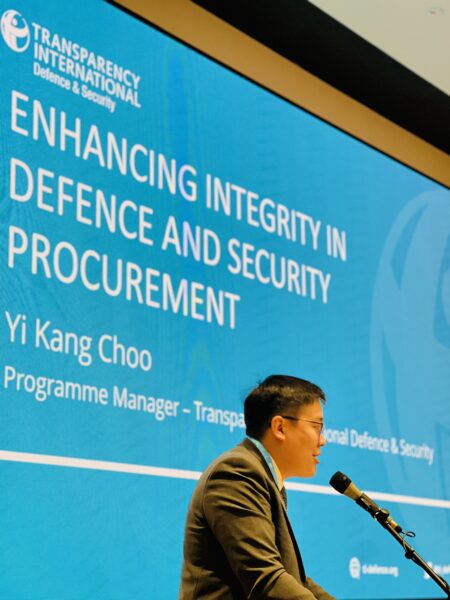
Enhancing Integrity in Defence and Security Procurement
At the panel, “Enhancing Integrity in Defence & Security Procurement”, our Project Manager, Yi Kang Choo joined Professor Christopher Yukins from George Washington University and Lt Col Dr Maimunah binti Omar, Assistant Director of Contemporary Security at the Malaysian Institute of Defence and Security (MiDAS) to explore how transparency and oversight can effectively mitigate corruption risks in defence and security.
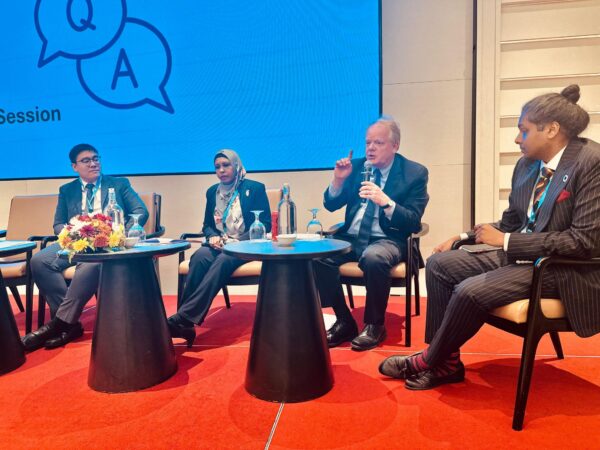
Yi Kang shared insights from the Government Defence Integrity (GDI) Index, which analyses corruption risks and institutional vulnerabilities in various facets of defence procurement. A key area of concern is offset agreements, which frequently lack sufficient scrutiny during negotiation, potentially leading to undue influence on decision-making in arms deals. Amongst countries analysed in the 2020 GDI, 53 per cent of countries globally have no law or policy in place to regulate offset contracts, and a further 59 per cent do not impose any form of due diligence requirements for these deals.
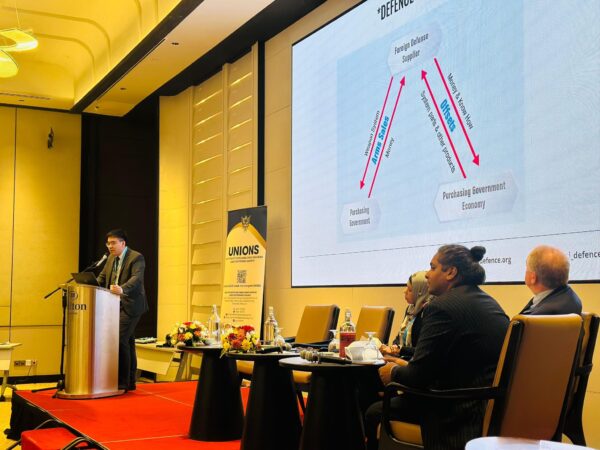
Furthermore, he pointed to the common absence of effective government monitoring and evaluation of the delivery of offset commitments. As outlined in our Defence Offsets report, the monitoring of offset programs is particularly demanding since it requires a correctly defined baseline scenario with a proper set of metrics to evaluate each result. The fact that offsets are sometimes expected to have social, technologic and other tacit outcomes, adds to the complexity of this task. Besides, drawing on the findings of our Unlocking Access report, Yi Kang elaborated on how the Tshwane Principles on National Security and the Right to Information offer a practical framework for striking a balance between ensuring public access to information and safeguarding legitimate national security interests.
Too often, national security exemptions are invoked in a vague, broad, and undefined manner, which curtail the timely release of critical information. This lack of transparency hinders public oversight and is particularly detrimental in a sector as critical as national security, where public interest is paramount. The Principles can be tailored to each country’s unique legal contexts and national priorities.
Thanks to UNODC and the organisers for having us. We are committed to continue working with decision-makers, industry, and civil society to raise the bar on transparency, accountability, and integrity in defence and security globally.