

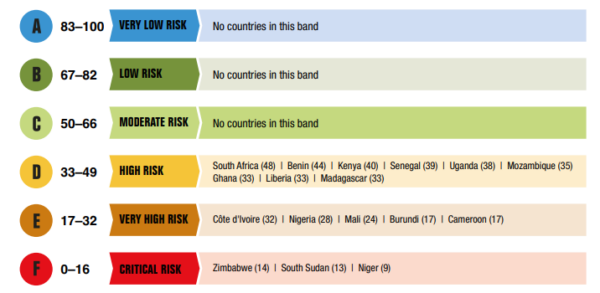
Transparency International Defence & Security has launched the report Resilience at Risk: Defence Governance in Sub-Saharan Africa, analysing the findings of the first wave of research of the 2025 Government Defence Integrity (GDI) Index published in March 2026. For this wave, 17 countries were assessed across Sub-Saharan Africa.
By Léa Clamadieu, Research Project Officer; Michael Ofori-Mensah, Head of Research; Patrick Kwasi Brobbey, GDI Project Manager; and Irasema Guzman, Research Project Officer.
Resilience at Risk: Defence Governance in Sub-Saharan Africa shows that across the region, defence governance operates within a challenging environment shaped by persistent security threats, political instability, and growing militarisation. These dynamics often expand the role of defence institutions in domestic, regional and international security – while increasing pressure on defence budgets. In such contexts, secrecy, exceptional procedures, and limited scrutiny can become entrenched, heightening corruption risks across the sector.
Overall 2025 GDI scores for Sub-Saharan Africa:
Regional Average Scores:
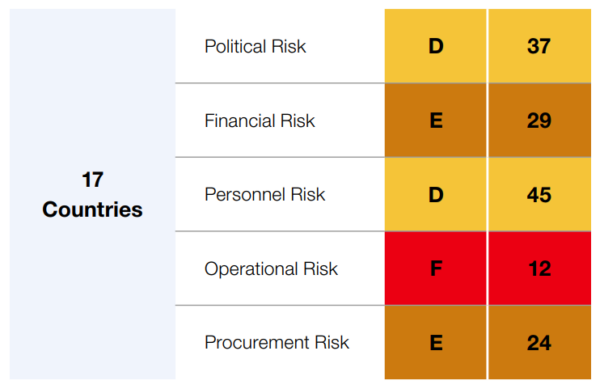
The report highlights three critical areas where governance deficits are most pronounced. Oversight of defence policy and budgets remains weak, constrained by executive dominance, limited access to information, and poor follow-up. Defence procurement is a systemic high-risk area, marked by opacity and weak controls. Military operations present the highest risks, where limited accountability and safeguards create significant vulnerabilities during deployments, undermining effectiveness and public trust. Together, these three areas illustrate how governance gaps are not isolated but reinforce one another, limiting effective scrutiny, enabling misuse of resources, and ultimately weakening both security outcomes and public trust in defence institutions.
Ineffective oversight of defence policy and budget
The regional 2025 GDI results show that oversight institutions formally exist across most countries but often function with limited authority and effectiveness.
Effectiveness of the oversight is constrained by several factors:
- Executive dominance frequently constrains parliamentary oversight of defence institutions.
- Restricted access to information prevents legislatures and audit bodies from fully scrutinising defence spending and activities.
- Weak follow-up mechanisms mean that oversight findings rarely translate into corrective action.
- In contexts of military rule or strong executive control, oversight tends to become reactive, symbolic, or procedural rather than substantive.
Weak oversight of defence policy and budgets is a key issue as it reduces accountability in defence decision-making and limits the ability of democratic institutions to monitor the use of public resources.
Defence procurement: where the risks run deep
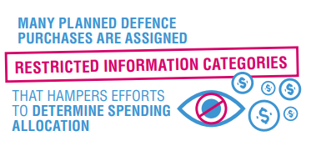
Defence procurement is one of the areas where governance risks consistently surface across Sub-Saharan Africa’s defence sectors. Although it represents one of the largest and most complex areas of public spending, the systems designed to safeguard it often fall short in practice. Moreover, while most countries have formal frameworks in place, these are frequently undermined in practice at a time when defence spending is rising across the region, amplifying both the scale of resources at stake and the potential risks of mismanagement.
Procurement decisions are not always aligned with national defence priorities, raising concerns about how resources are allocated. At the same time, procurement processes are often weakly structured, limiting traceability and making effective oversight difficult.
Limited competition is another major challenge. Security-based exemptions and restricted procedures are widely used, reducing transparency and increasing the risk of favouritism and inflated contracts. Even when irregularities are identified, enforcement is inconsistent, allowing poor practices to persist.
Military operations: critical corruption risks
GDI findings also show that military operations represent the highest corruption risk area across the region with a regional average score of 12/100 (Band F).
Regional Average Operational Risk Scores:
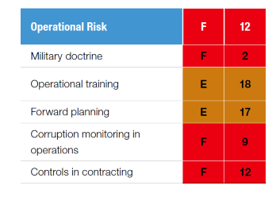
Military operations record the lowest regional scores in the GDI assessment. None of the 17 assessed countries have a military doctrine that addresses corruption risks in peace and conflict operations at the strategic, operational, and tactical levels. Moreover, accountability mechanisms during deployments are weak or absent and there are limited transparency and oversight during operations create opportunities for misuse of resources.
Implications are important, particularly in the region which faces many armed conflicts, as weak governance in operational contexts can undermine mission effectiveness, weaken discipline, and erode public trust, particularly in conflict-affected environments.
Conclusion
Resilience at Risk: Defence Governance in Sub-Saharan Africa highlights persistent governance vulnerabilities across Sub-Saharan Africa’s defence sectors, particularly in oversight, transparency, and operational accountability. These challenges are compounded by broader contextual pressures. Unconstitutional changes of government continue to weaken civilian oversight, while growing institutional stress within defence sectors reduces their ability to enforce safeguards. At the same time, rising military spending is outpacing the development of governance mechanisms, increasing the scale of resources exposed to corruption risks.
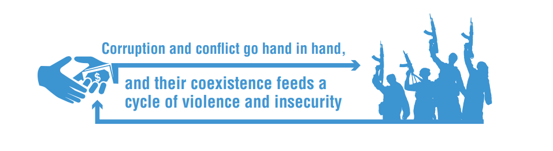
In this context, corruption in the defence sector is not a marginal issue as it directly undermines military effectiveness, diverts critical resources, and erodes public trust in security institutions. Left unchecked, it can fuel instability and weaken both state legitimacy and regional security.
Strengthening defence integrity must therefore be seen as central to democratic resilience. Enhancing oversight, improving financial transparency, and embedding integrity safeguards within military operations will be critical to reducing corruption risks and ensuring that defence institutions can effectively support security and stability.