

Public procurement is a cornerstone of governmental function, a powerful engine for national development and economic progress. When executed with integrity, it serves the public good. Left unchecked, it can become a magnet for waste, favouritism, and graft.
At the Regional Workshop on Integrity in Public Procurement (on 27-28 August 2025 in Sarawak, Malaysia), hosted by the United Nations Office on Drugs and Crime (UNODC) Regional Office for Southeast Asia and the Pacific and the State of Sarawak, we discussed with international and regional experts and government officials from Malaysia, Indonesia, and the Philippines on how to design and implement procurement processes that resists corruption. The workshop, themed “Integrity in Public Procurement: The Key in Economic Growth”, highlighted key integrity lessons for procurement:
- E-procurement from the outset: Leveraging technology effectively is paramount to embedding transparency across the procurement lifecycle – from initial planning and budgeting to implementation and oversight.
- Integrity is a strategic investment: Robust integrity measures, such as integrity pacts, require initial investment but their long-term dividends in reduced corruption, increased efficiency, and public trust far surpass the initial costs.
- No exceptions: The risk of corruption escalates significantly when checks and balances are weakened or bypassed. This is particularly true when exemptions are selectively applied. Integrity standards ought to apply consistently and universally across all sectors and contract sizes.
Enhancing Integrity in Defence and Security Procurement
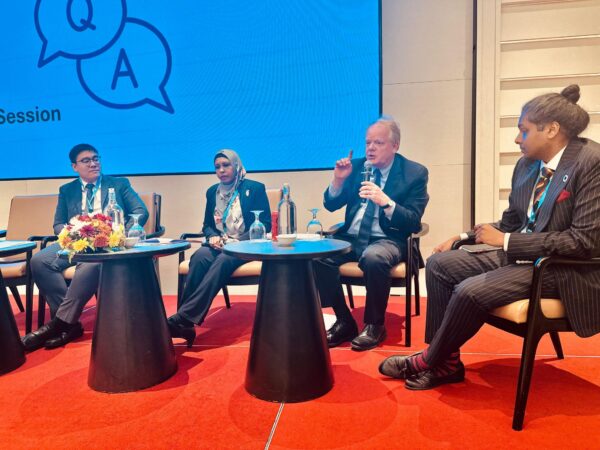
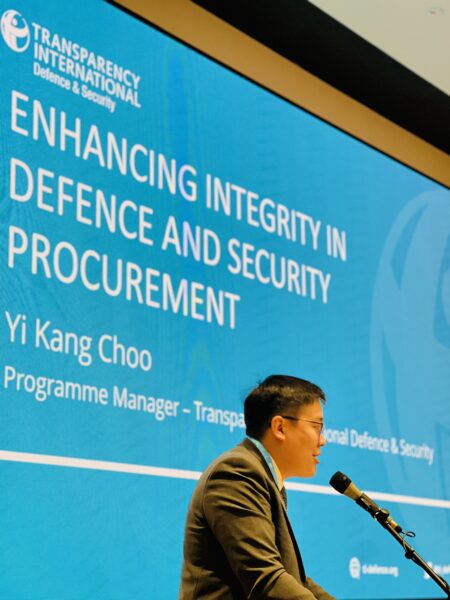
At the panel, “Enhancing Integrity in Defence & Security Procurement”, our Project Manager, Yi Kang Choo joined Professor Christopher Yukins from George Washington University and Lt Col Dr Maimunah binti Omar, Assistant Director of Contemporary Security at the Malaysian Institute of Defence and Security (MiDAS) to explore how transparency and oversight can effectively mitigate corruption risks in defence and security.
Yi Kang shared insights from the Government Defence Integrity (GDI) Index, which analyses corruption risks and institutional vulnerabilities in various facets of defence procurement. A key area of concern is offset agreements, which frequently lack sufficient scrutiny during negotiation, potentially leading to undue influence on decision-making in arms deals. Amongst countries analysed in the 2020 GDI, 53 per cent of countries globally have no law or policy in place to regulate offset contracts, and a further 59 per cent do not impose any form of due diligence requirements for these deals.
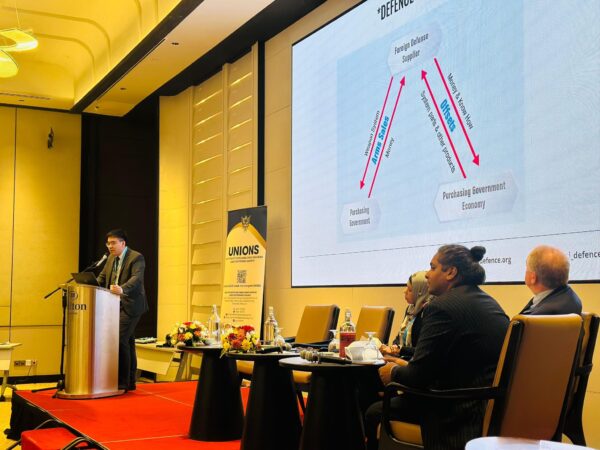
Furthermore, he pointed to the common absence of effective government monitoring and evaluation of the delivery of offset commitments. As outlined in our Defence Offsets report, the monitoring of offset programs is particularly demanding since it requires a correctly defined baseline scenario with a proper set of metrics to evaluate each result. The fact that offsets are sometimes expected to have social, technologic and other tacit outcomes, adds to the complexity of this task. Besides, drawing on the findings of our Unlocking Access report, Yi Kang elaborated on how the Tshwane Principles on National Security and the Right to Information offer a practical framework for striking a balance between ensuring public access to information and safeguarding legitimate national security interests.
Too often, national security exemptions are invoked in a vague, broad, and undefined manner, which curtail the timely release of critical information. This lack of transparency hinders public oversight and is particularly detrimental in a sector as critical as national security, where public interest is paramount. The Principles can be tailored to each country’s unique legal contexts and national priorities.
Thanks to UNODC and the organisers for having us. We are committed to continue working with decision-makers, industry, and civil society to raise the bar on transparency, accountability, and integrity in defence and security globally.