

Show Index: gdi
The perception of transparency in defence needs to change. Currently, secrecy is often the norm and transparency is the exception. Instead, transparency should be the norm and secrecy the exception.
Despite robust and widely agreed international and national anti-corruption and freedom of information legislation that governs public sectors, the defence sector remains secretive and lacking a fundamental level of transparency that is crucial to ensure accountability. Such legislation frequently contains national security exemptions that are vague, undefined or overreaching and provide defence institutions with a sweeping mandate to classify information by labelling it critical to national security.
Russia’s war in Ukraine has made slow progress amid a catalogue of corruption-related blows to the morale of its military. Josie Stewart and Joseph Moore chart the stalling of long-standing attempts to control Ukraine.
When Vladimir Putin launched Russia’s invasion of Ukraine in the early hours of that cold February morning a year ago, his plan represented a shock and awe offensive, aimed at encircling the capital Kyiv until the capitulation of the Ukrainian army and, eventually, the annexation of Ukraine. Even amongst Western observers, there was scepticism that Ukraine could effectively counter Russia.
This was the next step in a strategy which had already seen Putin spend two decades trying to control Kyiv through weaponised strategic corruption: enriching pro-Russian oligarchs in Ukraine such as Dmytro Firtash or Viktor Medvedchuk, who in turn bought up news channels, bankrolled political parties, and steadily built up Ukraine’s political and economic dependence on Russia.
But when corruption is used as a weapon, it can backfire.
Up until recently, the Russian army was praised as one of the world’s most powerful militaries. Today, one year on from the escalated invasion, having already suffered staggering loses with an estimated 200,000 dead and wounded soldiers, Russia’s ill-predicted quick victory seems a long way away.
There is no question that the war has not gone as Putin hoped. How much of this is because a reliance on corruption has come back to bite him?
Back in 2008, Russia embarked on the task of modernising its military forces. This process entailed a rapid increase in defence spending: 175 per cent growth from 2000-2019, according to Stockholm International Peace Research Institute. This peaked in 2016 at 5.5 per cent of gross domestic product (GDP). That’s a lot of spending in a context where public sector corruption is rife.
Our most recent Corruption Perceptions Index ranked Russia 137th out of 180 countries and Russia’s military is not immune. Our Government Defence Integrity Index 2020 assessed Russia’s defence sector as being at high risk of corruption, due to the extremely limited oversight of defence-related policies, budgets, activities and acquisitions, in conjunction with high levels of opacity in defence procurement.
As a result, bribe money intended to buy a Ukrainian coup was stolen before it could leave Russian hands, soldiers on the front line were provided with ration packs seven years out of date, crowdsourcing for body armour was required for troops not properly equipped for the war, fuel was sold on the black market before it could power Russian tanks and supply chains failed. Ultimately as a result of this all – Russian morale suffered.
The UK Ministry of Defence’s intelligence updates further supported this and flagged ‘corruption amongst commanders’, with the “Russian military… consistently [failing] to provide basic entitlements to troops deployed in Ukraine… almost certainly contributing to the continued fragile morale of much of the force.” The Head of Ukraine’s National Agency on Corruption Prevention of Ukraine (NACP) also expressed his “sincere gratitude” to Russian Defence Minister Sergei Shoigu – who is alleged to own property worth at least $18 million (somehow reportedly acquired on his official annual salary of $120,000) – for the “invaluable contribution” Russian embezzlement had provided in better enabling the defence of Ukraine.
In contrast to the corruption-related problems that have plagued the effectiveness of Russia’s Army from the start, Ukraine has invested in improving oversight and accountability, action initiated following the annexation of Crimea in 2014. Our colleagues at the Independent Defence Anti-Corruption Committee (NAKO) have been working closely with the Ukrainian Government on this since 2016. Ukraine is continuing to fight corruption at the same time as fighting on the battlefield. With the stakes this high, they know they must win on both fronts.
At Transparency International Defence and Security we have long argued that a failure to strengthen defence governance together with increases in defence spending increases the risk of corruption – and that corruption in defence undermines military effectiveness. In other words: it’s not just how much you spend that determines the outcome. Russia’s challenges in Ukraine only reinforce this argument.
Responding to the United Nations Security Council all-day debate on the Rule of Law Among Nations, Josie Stewart, Director of Transparency International Defence and Security, said:
United Nations Secretary General Antonio Guterres last week reflected on the “strong and mutually reinforcing relationship between the rule of law, accountability and human rights”, describing how “ending impunity is fundamental”.
Our Government Defence Integrity Index (GDI) facilitates such accountability by shining a light on the level of resilience to corruption — and independence of institutions — in countries as diverse as Israel and Mali.
Drawing on evidence contained within the GDI reveals critical steps governments can take to prevent the spectre of a “new rule of lawlessness” — a danger raised by Guterres at the Special Council session on January 12 .
press@transparency.org.uk
+ 44 (0)20 3096 7695
Out of hours – Weekends; Weekdays (UK 17.30-21.30): +44 (0)79 6456 0340
In response to the review of the UK’s aid investment in Afghanistan published this week by the UK Independent Commission on Aid Impact (ICAI), Josie Stewart, Director of Transparency International Defence and Security, said:
“This review adds to the now sky-high pile of evidence that corruption was central to the tragic downfall of the country. Corruption within the security services was particularly damaging, undermining the cohesion and operational capacity of the army and police. Arms and equipment were stolen, and sold to the Taliban.
“Following the downfall of Kabul last year, Khalid Payenda, Afghanistan’s former finance minister, said that most Afghan troops on the payroll had in fact been ‘ghost’ soldiers, made up by corrupt officials who exploited the system for money. The operational capability of soldiers who did not actually exist had proven to be, unsurprisingly, limited.
“ICAI’s new report highlights that the UK provided over £400 million in aid over just six years to fund the Afghan security services, including paying the salaries of the Afghan National Police who acted primarily as a paramilitary force engaged in counter-insurgency operations against the Taliban. We will never know how much of this £400 million was stolen, how much indirectly funded the Taliban, or how much it contributed to the overestimation of the Afghan security forces’ operational capability which led to such devastating consequences for the Afghan government, its NATO partners, and the Afghan people. But anyone who cares about global peace and security must learn the lessons from Afghanistan.”
press@transparency.org.uk
+ 44 (0)20 3096 7695
Out of hours – Weekends; Weekdays (UK 17.30-21.30): +44 (0)79 6456 0340
In response to reports the United Kingdom’s new National Security Bill could offer ministers immunity from enabling torture abroad, Josie Stewart, Director of Transparency International Defence and Security, said:
“If the UK wants to maintain its leadership role advocating for integrity in military institutions worldwide it must maintain the same stringent accountability standards in its operations abroad as at home. Cases of wrongdoing and malpractice must be investigated and prosecuted through formal processes, without undue political influence.”
Our latest research catalogues conflict and corruption around the word – harm caused by leaving the privatisation of national security to grow and operate without proper regulation.
Post-Afghanistan, exploitation of global conflicts is big business. Most private military and security firms are registered in the US, so we are calling on Congress to take a leading role in pushing through meaningful reforms under its jurisdiction. The time has also come for accreditation standards to be enforced rather than only encouraged, at both a national and international level.
Michael Ofori-Mensah, Head of Research at Transparency International Defence and Security, describes some of the dangers documented in our latest research paper.
Unaccountable private military and security companies continue to pursue partnerships that in recent years have led indirectly to the assassination of presidents and journalists, land grabs in conflict zones, and even suspected war crimes.
From Haiti to Saudi Arabia to Nigeria, US-based organisations – the firms that dominate the market – have found themselves associated with a string of tragedies, all while their sector has grown ever-more lucrative.
Transparency International Defence and Security’s latest research – ‘Hidden Costs: US private military and security companies and the risks of corruption and conflict – catalogues the harm playing out internationally as countries increasingly seek to outsource national security concerns to soldiers of fortune.
Hidden costs from the trade in national security
While the US and other governments have left the national security industry to grow and operate without proper regulation, the risks of conflict being exploited for monetary gain are growing all the time.
Hidden Costs documents how the former CEO of one major US private military and security company was convicted – following a guilty plea – of bribing Nigerian officials for a US$6bn land grab in the long-plundered Niger Delta.
Our research also highlights that the Saudi operatives responsible for Jamal Khashoggi’s savage murder received combat training from the US security company Tier One Group.
Arguably most damning are the accounts from Haiti, where the country’s president was killed last year by a squad of mercenaries thought to have been trained in the US and Colombia.
Pressing priority
Many governments around the world argue that critical security capability gaps are being filled quickly and with relatively minimal costs through the growing practise of outsourcing.
Spurred on by the US government’s normalisation of the trade, US firms are growing both their services and the number of fragile countries in which they operate.
The private military and security sector has swelled to be worth US$224 billion. That figure is expected to double by 2030.
The value of US services exported is predicted to grow to more than $80 billion in the near future, but the industry and the challenge faced is global.
The risks of corruption and conflict in the pursuit of profits are plain.
These risks are as old as time. But their modern manifestations in warzones must not be left to spill over. The 20-year war in Afghanistan cultivated dynamics that threaten further damage, more than a decade after governments first expressed their concerns.
Required response
International rules and robust regulation are urgently needed. We need measures that ensure mandatory reporting of private military and security company activities. The Montreux Document lacks teeth, operating as it does as guidance that is not legally binding. Code of conduct standards must also become mandatory for accreditation, rather than purely voluntary.
Most private military and security firms are registered in the US. So Transparency International Defence and Security is also calling on Congress to take a leading role in pushing through meaningful reforms under its jurisdiction. There is an opportunity arriving in September, when draft legislation faces review.
Policymakers have long been aware of the corruption risks and the related threats to peace and prosperity posed by this sector. The time for action is well overdue. No more Hidden Costs.
Work is underway to shape policies necessary for the prevention of further coups in Mali, following two recent military takeovers of the west African nation.
Mali has been operating under what leaders have described as a period of “transitional” military governance since August 2020, with elections repeatedly delayed.
Transparency International is embarking on a new project aimed at establishing policies that would prevent future coups being carried out and see corruption threats mitigated in the nation’s defence and security sector, assessed as “high risk” through our Government Defence Integrity Index.
The initiative supported by the United Nations Democracy Fund aims to empower ordinary Malians and their civil society organisations to “exercise oversight” and engage with government representatives and defence institutions in reforming defence governance.
Legislative foundations will be laid in preparation for the resumption of parliamentary work following a two year hiatus that has seen female representation in positions of political influence shrink to zero.
‘Power to convene’
The project will be delivered through a partnership between Transparency International’s national chapter — CRI 2002 — and TI-UK.
Working together we combine national level civil society legitimacy, contextual understanding and power to convene with global expertise in corruption in the defence sector.
We will partner with local journalists and with a civil society network — the CSO Forum created under the previous UNDEF project — while expanding the project’s reach to all 10 of the country’s regions.
We will present policy recommendations to the National Transition Council (NTC), with whom we are already engaged, to integrate into legislation once the National Assembly resumes.
Three-pronged approach
Our approach is underpinned by three activities:
- In-depth research into the role that corruption can play in facilitating military coups. The paper we produce will identify policy recommendations to anticipate and prevent future coups in Mali. It will also signpost risks to other countries facing similar challenges.
- Analysis of the defence sector’s performance during the COVID-19 emergency. Our briefing will focus on the impact of corruption during emergencies and how it undermines the country’s capacity to respond to disasters. The analysis will include policy recommendations that can inform disaster risk reduction (DRR) interventions.
- An advocacy program for CSOs to facilitate engagement with the National Transition Council and defence institutions. This will encourage integration of policy recommendations into legislation.

The Government Defence Integrity Index (GDI) measures institutional resilience to corruption in the defence sector by focusing on both policymaking and public sector governance in national defence establishments. It is the first global analysis of institutional and informal controls to manage the risk of corruption in defence and security institutions. It measures resilience in five broad risk areas of defence: policymaking, finances, personnel management, operations, and procurement. This report examines the findings from the 2020 iteration of the GDI, which comprises 86 individual country assessments, all published between October 2019 and November 2021.
These country assessments form the basis of this research report which examines how key findings from the index fit into broader global geopolitical and governance trends. In doing so, the report also outlines an extensive framework of good practice that promotes accountable, transparent, and responsible defence governance.
The report’s conclusions give serious cause for concern. Nearly two thirds of defence sectors in all regions and economic groups present high to critical levels of corruption risk. While overall performance is poor across all five risk areas assessed, military operations stand-out as the most compromised risk area. The arms trade is another significant area of corruption risk, with 49% of global arms imports going to countries with high to critical corruption risk in the defence sector.
A positive finding from analysis of the GDI data is that some of the largest military spenders and defence exporters also have the highest levels of transparency. Confidentiality, therefore, is not an essential pre-condition for a strong defence sector but a political decision.
By Ara Marcen Naval, Head of Advocacy at Transparency International Defence & Security
Last week the US President issued a government memorandum making corruption a core national security concern.
Transparency International’s new research reveals there is good cause for concern. The 2020 Government Defence Integrity Index (GDI) shows that nearly two-thirds of countries – 62 per cent – face a high to critical risk of corruption in their defence and security sectors.
Countries that score poorly in the GDI have weak or non-existent safeguards against defence sector corruption. They are more likely to experience conflict, instability, and human rights abuses. Sudan, which has just undergone a military coup, came bottom of the Index with a score of 5/100 while New Zealand came top with a score of 85/100.
The GDI findings should ring alarm bells in governments around the world; particularly as global military spending has increased to some $2 trillion annually, fuelling the scale and opportunity for abuse.
Corruption in a nation’s defence institutions weakens security forces and threatens wider peace and stability. It eats away at public trust in the state and the rule of law, giving vital oxygen to non-state and extremist armed groups. It leaves governments unable to properly protect their citizens – their primary function. We have seen examples time and time again. Think of Iraq, when in 2014 50,000 ‘ghost soldiers’ (troops that exist only on paper) were found on the books. Their salaries were either stolen by senior officers or split between soldiers and high-ranking officers. The phenomenon has a human and financial cost leaving forces depleted, unprepared to face real threats and unable to fulfil their mandate to protect citizens and provide national security.
The GDI provides defence institutions across 86 nations with a comprehensive assessment of their corruption risk and a platform to identify the safeguards needed to prevent corruption. It does not measure corruption itself. It is not concerned with calculating stolen government funds, identifying corrupt figures, nor even estimating how corrupt the public thinks their defence forces are.
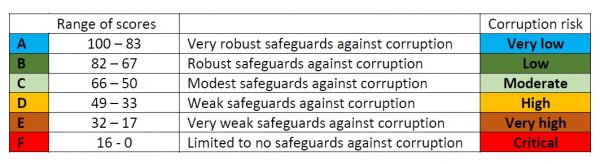
Rather, the GDI offers a roadmap for better governance of the defence sector. It maps out gaps in policies and practices that can prevent corruption and provides standards that countries can follow to strengthen their systems, across five main risk areas: policymaking and political affairs, finances, personnel management, military operations, and procurement. It assigns a score out of 100 and ranks countries from A (very robust safeguards) to F (limited to no safeguards against corruption).

Military operations
The GDI results are particularly poor when it comes to military deployments for internal security operations and peacekeeping missions overseas. Almost every country assessed performs badly in terms of anti-corruption safeguards in this area. That includes nations most actively engaged in international missions. Bangladesh scores 0/100 operationally yet is the top contributor of uniformed troops to UN peacekeeping missions.
Countries facing internal threats fare no better when it comes to military operations. A lack of anti-corruption safeguards means troops may be more likely to contribute to exacerbating conflict rather than bringing about peace.
These findings leave little doubt that governments are overlooking the corrosive impact of defence and security corruption despite its clear threat to peace, stability and human life.
Arms trade
The GDI also reveals significant corruption risks among the world’s major arms suppliers and recipients.
Eighty-six percent of global arms exports between 2016-2020 were from countries with a moderate to very high risk of corruption. For major arms suppliers, the GDI exposes poor parliamentary scrutiny, transparency and oversight in export and procurement processes. The top five exporters accounted for 76% of the global total.
Meanwhile, just under half – 49% – of global arms imports are to countries with a high to critical risk of defence corruption. These countries lack the policies and systems to independently oversee these deals or how these weapons will be used. Nor do they provide meaningful data on how they choose which companies to buy from or whether any third parties are involved. This lack of transparency leaves the door wide open to bribery, theft of public money and to weapons finding their way into the hands of criminal gangs or insurgent groups.
Overall, the GDI paints a dismal picture of a defence sector that continues to operate in secrecy, with inadequate policies and procedures to mitigate high corruption risks. This lack of transparency and accountability sets the scene for government activity that has devastating consequences for civilians and global security.
If governments are serious about building national and international security and stability, they must embed transparency and anti-corruption at the core of defence institutions. Getting this right is vital to averting future conflict, failed interventions and the devastating human cost that comes with them. To see the GDI results in detail go to https://ti-defence.org/gdi
November 16, 2021 – The 2020 Government Defence Integrity Index (GDI) released today by Transparency International Defence & Security reveals nearly two-thirds of countries face a high to critical risk of corruption in their defence and security sectors.
Countries that score poorly in the GDI have weak or non-existent safeguards against defence sector corruption and are more likely to experience conflict, instability, and human rights abuses.
The results come as global military spending has increased to some $2 trillion annually, fuelling the scale and opportunity for corruption.
The GDI assesses and scores 86 countries across five risk areas: financial, operational, personnel, political, and procurement, before assigning an overall score. It uses the following scale:
Global highlights
- 62% of countries receive an overall score of 49/100 or lower, indicating a high to critical risk of defence sector corruption across all world regions.
- New Zealand tops the Index with a score of 85/100.
- Sudan, which just last month saw the military seize power in a violent coup, performs the worst, with an overall score of just 5/100.
- The average score for G20 countries is 49/100.
- Almost every country scores poorly in terms of its safeguards against corruption in military operations. The average score in this area is just 16/100 because most countries lack anti-corruption as a core pillar of their mission planning.
- Among those that scored particularly poorly in this area are key countries contributing to or leading major international interventions such as Bangladesh (0/100).
- 49% of global arms imports are sold to counties facing a high to critical risk of defence corruption.
Natalie Hogg, Director of Transparency International’s Defence and Security Programme, said:
“These results show that most defence and security sectors around the world lack essential safeguards against corruption. Defence sector corruption undermines defence forces, weakening their ability to provide security to citizens, secure national borders and bring about peace. In the worst cases defence sector corruption has the potential to exacerbate conflict rather than to respond to it effectively.
“We urge all governments featured in this Index to act on these findings. They must strengthen their safeguards against corruption and remove the veil of secrecy that so often prevents meaningful oversight of the defence sector. It’s critical that they embed anti-corruption at the core of all military operations to stop corruption and its devastating impact on civilians around the world.”
Implications for military operations
Almost every country performs badly in the military operations risk area. The GDI assesses the strength of anti-corruption safeguards in military deployments, whether that be deploying troops for internal security purposes or sending them on a peacekeeping mission overseas.
Only New Zealand has a low risk of corruption in its military deployments (operations score of 71/100), while a handful of countries perform moderately well in this area, including the UK (operations score of 53) and Norway (50).
Eighty-one countries face a high to critical risk in their military operations. This poses serious questions for countries facing internal threats, where a lack of anti-corruption safeguards in operations means troops are far more likely to contribute to conflict than quell it.
The lack of corruption safeguards in military operations should also be alarming to governments involved in international interventions through regional and international organisations. For example, Bangladesh (operations score of 0/100) is the top contributor of uniformed troops to UN peacekeeping missions.
Natalie Hogg, Director of Transparency International’s Defence and Security Programme, said:
“The lack of safeguards against corruption in military operations by many countries most actively involved in international interventions is particularly worrying. Time and time again international forces have failed to take the corrosive impact of defence and security corruption seriously despite the clear threat it poses to peace and stability. Getting this right is vital to averting future failed interventions and the devastating human cost that comes with them.”
Corruption in the arms trade
The GDI shows that 86% of global arms exports between 2016-2020 originate from countries at a moderate to very high risk of corruption in their defence sectors.
Meanwhile, 49% of global arms imports are to counties facing a high to critical risk of defence corruption.
These countries do not allow lawmakers, auditors or civil society to scrutinise arms deals, nor do they provide meaningful data on how they choose which companies to buy from or whether any third parties are involved.
This lack of transparency leaves the door wide open to bribery, public money being wasted and weapons finding their way into the hands of criminal gangs or insurgent groups.
Given the devastating impact on human life and security that corruption continues to have through the licit and illicit global arms trade, it is vital that both exporting and importing governments have strong anti-corruption measures and transparency.
Notes to editors:
About Transparency International
Through chapters in more than 100 countries, Transparency International has been leading the fight against corruption for the last 27 years.
The GDI is produced by Transparency International’s Defence and Security Programme, based in London, UK.
About the Government Defence Integrity Index
The GDI is the only global assessment of the governance of and corruption risks in defence sectors.
The GDI was previously known as the Government Defence Anti-Corruption Index (GI). The Index underwent a major update for the 2020 version, including changes to the methodology and scoring underpinning the project. This means overall country scores from this 2020 version cannot be accurately compared with country scores from previous iterations of the Index.
For more information, visit www.ti-defence.org/gdi/about
Contact:
Harvey Gavin
harvey.gavin@transparency.org.uk
+44 (0)20 3096 7695
+44 (0)79 6456 0340 (out of hours)
Transparency International Defence & Security will release the full results of its Government Defence Integrity Index on Tuesday, November 16 at 00.01 CET.
The Government Defence Integrity Index (GDI) is the only global assessment of corruption risks in the defence and security sector. It provides a snapshot of the strength of anti-corruption safeguards in 86 countries.
More on the GDI: https://ti-defence.org/gdi/about/
The GDI highlights a worrying lack of safeguards against corruption in defence and security sectors worldwide. It also shows countries contributing to or leading major international interventions lack key anti-corruption measures in their overseas operations.
Full results and scores for countries will be published here at 00.01 CET on Tuesday, November 16: https://ti-defence.org/gdi/map/
To request interviews or press materials under embargo until publication, please email the Transparency International UK press office press@transparency.org.uk