

Show Index: gdi
Our research shows Freedom of Information regimes in countries across the world are not good enough at protecting the public’s right to know
By Ara Marcen and Najla Dowson-Zeidan
The ‘right to know’ for citizens to learn what public institutions are doing on their behalf is a crucial component of human rights law, and vital to combat corruption by providing transparency and accountability. But as with all rights, there is often a big difference between being entitled to them and being able to realise them. With the right of access to information, nowhere is this gulf more apparent than in the defence and security sector.
Militaries, security institutions and ministries of defence are notoriously opaque. Despite robust international (and some national) anti-corruption and freedom of information legislation that governs public sectors, the defence sector is frequently given a green light to remain secretive and evade accountability by utilising the ‘national security’ exemptions so often contained in this legislation. The result is that secrecy is often the norm and transparency the exception.
This approach to transparency in defence needs to change. The secretive nature of defence, and a lack of transparency and access to information, impairs civilian control of the security sector, hampers oversight bodies and increases corruption risks at all levels. It allows corruption to occur unexposed, unaddressed, and in the shadows.
Transparency should be the norm and secrecy the exception. While some information in the defence sector may need to remain classified for legitimate national security reasons, this should be a well-founded exception – not a rule. Maintaining high levels of secrecy limits scrutiny and allows the vicious circle of secrecy, opportunity for corrupt acts and self-enrichment to flourish.
This International Right to Know Day, we call on all governments and public authorities to limit the opacity around security to only the most sensitive information – where the likelihood of harm as a result of its disclosure clearly outweighs the harm to the public interest in withholding it – so national security is not a pretext for limiting citizens’ right to information. Defence and security sectors should not be treated as exceptional when it comes to the public’s right to know how their money is being spent and how key policy decisions are being made.
Initial findings of our global Government Defence Integrity Index, a vast pool of data that assesses how government defence institutions protect themselves against the risk of corruption, show that in most countries there is a long way to go to make mechanisms for accessing information from the defence sector effective. Of the 86 countries assessed, almost half were assessed as at a high to critical risk of corruption in relation to their access to information regimes, meaning that the legal frameworks for access to information, implementation guidelines, and effectiveness of practice at the institutional level are currently not good enough at upholding citizens’ right to access information.
Weaknesses in legal frameworks regulating access to information in defence expose countries to high levels of corruption risk as they reduce transparency and hamper effective oversight of the sector. However, the implementation of these frameworks in practice presents even more significant risks. Poor implementation of Access to Information regulations in defence makes information extremely difficult to obtain and undermines the effectiveness of legislation.
The GDI data shows a significant implementation gap; even where legal frameworks are in place, most countries score less well in terms of actually putting this into practice The vast majority of countries fall well short of the good practice standard for implementation, whereby ‘the public is able to access information regularly, within a reasonable timeline, and in detail’. Most were assessed as having at least some shortcomings in facilitating access to defence-related information to the public (for example, delays in access or key information missing), and in more than one in three of the countries assessed the public is rarely able to access information from the defence sector, if at all. While corruption in every sector wastes resources and undermines trust between the state and its citizens, corruption in the defence and security sector, among institutions tasked with keeping peace and security, has a particularly detrimental impact. In fragile and conflict states, corruption – both a cause and a consequence of conflict – frequently permeates all areas of public life.
And the costs of this are high – both financially (with annual global military expenditure estimated to be almost $2 trillion[1]) and in terms of human security. Corruption damages populations’ conception of the legitimacy of central authorities, threatens the social contract, and ultimately the rule of law and attainment of human rights.
The right to information and transparency are key pillars for good governance and accountability and are crucial tools in the fight against corruption. They enable external oversight of government – and the military – by legislators, civil society and the media, increasing accountability of political decision-making and institutional practice. They enable informed participation of the public and civil society in public debates and development of policy and law. And they bring corruption risks – and actual incidents of corruption – to light, facilitating the push for accountability and reform.
Recommendations:
We’re calling on states to renew their commitment to the right to information. They need to ensure that their national legal frameworks include laws that enable the public to exercise the right of access to information across all sectors. Rules for classification and declassification must be rigorous and publicly available, with clearly defined grounds for classifying information, established classification periods. And there should be the possibility of appeal for those who wish to access information withheld in Freedom of Information proceedings.
Defence institutions should have in place rigorous and publicly available rules for withholding information, with clearly defined procedures and grounds for classifying information, established classification periods, and a possibility of appeal for those who wish to access information withheld in Freedom of Information proceedings. They should be accompanied by clear criteria and process for public interest and harm tests that can help balance genuine needs for secrecy with overall public interest. Adopting and endorsing the Global Principles on National Security and the Right to Information (the Tshwane Principles) would be a good step towards having the right access to information regime in place.
To make sure that secrecy does not trump the right to know – and to strengthen the ability of defence institutions to protect themselves against the risk of corruption – governments should consider these key principles:
- Freedom of information is a right. Any limitations of this should be the exception, not the rule.
- Transparency is a key tool against corruption. Enabling public scrutiny, rather than undermining a public institution, can lead to better use of resources and reduce risk of corruption.
- The interest of preventing, investigating, or exposing corruption should be considered as an overriding public interest in public interest and harm tests, as corruption is not only a waste of public resources, but also seriously undermines the national security efforts of a country.
For more on Access to Information in the defence sector, see our factsheet.
[1] https://www.sipri.org/media/press-release/2021/world-military-spending-rises-almost-2-trillion-2020
May 6, 2021 – Close links between the defence industry and governments in Europe are jeopardising the integrity and accountability of national security decisions, according to a new report by Transparency International – Defence and Security.
Defence Industry Influence on Policy Agendas: Findings from Germany and Italy explores how defence companies can influence policy through political donations, privileged meetings with officials, funding of policy-focused think tanks and the ‘revolving door’ between the public and private sector.
These ‘pathways’ can be utilised by any business sector, but when combined with the huge financial resources of the arms industry and the veil of secrecy under which much of the sector operates, they can pose a significant challenge to the integrity and accountability of decision-making processes – with potentially far-reaching consequences.
This new study calls on governments to better understand the weaknesses in their systems that can expose them to undue influence from the defence industry, and to address them through stronger regulations, more effective oversight and increased transparency.
Natalie Hogg, Director of Transparency International – Defence and Security, said:
“When individuals, groups or corporations wield disproportionate or unaccountable influence, decisions around strategy and expenditure can be made to benefit private interests rather than the public good. In defence, this can lead to ill-equipped armed forces, the circumvention of arms export controls, and contracts that line the pockets of defence companies at the public’s expense.
“The defence and security sectors are a breeding ground for hidden and informal influence. Huge budgets and close political ties, combined with high levels of secrecy typical of issues deemed to be of national security, means these sectors are particularly vulnerable. Despite the serious risk factors, government oversight systems and regulations tend to be woefully inadequate, allowing undue influence to flourish, with a lot to gain for those with commercial interests.”
Transparency International – Defence and Security calls on states to implement solutions to ensure that their defence institutions are working for the people and not for private gain.
Measures such as establishing mandatory registers of lobbyists, introducing a legislative footprint to facilitate monitoring of policy decisions, strengthening conflict of interest regulations and their enforcement, and ensuring a level of transparency that allows for effective oversight, will be important steps towards curbing the undue influence of industry over financial and policy decisions which impact on the security of the population.
Notes to editors:
Defence Industry Influence on Policy Agendas: Findings from Germany and Italy is based on two previous reports which take an in-depth look at country case studies. The two countries present different concerns:
- In Italy, the government lacks a comprehensive and regularly updated defence strategy, and thus tends to work in an ad hoc fashion rather than systematically. A key weakness is a lack of long-term financial planning for defence programmes and by extension, oversight of the processes of budgeting and procurement.
- In Germany, despite robust systems of defence strategy formation and procurement, significant gaps in capabilities have led to an overreliance on external technical experts, opening the door to private sector influence over key strategic decisions.
The German report can be found here and the Italian report here.
The information, analysis and recommendations presented in the case studies were based on extensive document review and more than 50, mainly anonymous, interviews.
Contact:
Harvey Gavin
harvey.gavin@transparency.org.uk
+44 (0)20 3096 7695
+44 (0)79 6456 0340 (out of hours)
The risks and impacts of inappropriate influence in the policy-making process, in which individuals or organisations try to persuade in favour of, or force their own agenda, are particularly significant in the defence and security sector. In this context, high levels of secrecy and complexity, combined with close relations between government, private experts, and the defence industry, converge to create a potentially fertile ground for private interests to thrive. Yet when individuals, groups or corporations wield disproportionate or unaccountable influence, this undermines the public good and public funds may be squandered.
This situation is further complicated by the different roles a government plays with respect to its defence industry, being simultaneously both the main customer and the main regulator. Because the government is reliant on the national defence industry for the fulfilment of one of its core obligations – providing defence and security for its citizens – it is easy to see how lines in the relationship between the two roles can easily become blurred. If unchecked, the influence of the defence industry can damage the integrity of state institutions and distort the aims of a national security strategy, while undermining market competition and good defence sector governance.
This paper presents the main findings from two case studies on the influence of the defence industry on the defence and security policy agendas of Germany and Italy. The aim of the studies was to identify pathways of potential undue influence and to make proposals for a more ethical relationship between the defence industry and policy-making entities. This paper provides a summary of the main findings from each study and presents a preliminary framework for understanding the factors that drive the exploitation of these pathways of influence.
By Julien Joly, Thematic Manager, Corruption, Conflict and Crisis, Transparency International Defence & Security
Corruption, conflict and instability are profoundly intertwined. It has been shown time and again that corruption not only follows conflict but is also frequently one of its root causes.
Broadly speaking, corruption fuels conflict in two ways:
- By diminishing the effectiveness of national institutions; and
- By generating popular grievances.
Both of these elements contribute to undermining the legitimacy of the state, and in conflict this can empower armed groups who present themselves as the only viable alternative to corrupt governments. In turn this further contributes to the erosion of the rule of law, thus fuelling a vicious cycle.
Despite this, relatively little attention has been given to addressing corruption through peacebuilding efforts. As corruption is increasingly recognised for its role in fuelling conflict and insecurity around the world, it is imperative that initiatives seeking to address the root causes of violence and build lasting peace take this into consideration.
As a key element of the post-conflict peacebuilding agenda, Security Sector Reform (SSR) lends itself ideally to address the nexus between corruption and conflict. Applying the principles of good governance to the security sector to ensure that security forces are accountable offers legitimate avenues to mitigate corruption.
Nonetheless, evidence shows that strategies to mitigate corruption often fail to receive sufficient attention when it comes to designing and implementing SSR programmes. Such programmes overwhelmingly target tactical and operational reforms, designed for instance to train security forces or provide them with weapons and equipment, at the expense of structural reforms which would focus on bolstering accountability and reducing corruption. Similarly, in SSR policy frameworks developed by international and regional organisations, corruption is too often mentioned superficially and largely marginalised in favour of the ‘train-and-equip’ approaches described above. However, since the emergence of the concept of Security Sector Reform (SSR) in the 90s, there has been a shift from state-centric notions of security to a greater emphasis on human security. In this paradigm, based on the security of the individual, their protection and their empowerment, traditional ‘train-and-equip’ approaches to SSR have shown their limits.
It is clear that transparency, accountability, and anti-corruption are vital to ensure that security sector governance is effective. This means developing new approaches to SSR that, among other things, address corruption effectively.
In many areas, the anti-corruption community and the peacebuilding community would benefit from each other’s expertise. Reforming human resources management and financial systems, strengthening audit and control mechanisms, supporting civilian democratic oversight: these are areas where anti-corruption practitioners have been developing significant expertise over the past decades. They also happen to be key components of SSR.
But drawing from this expertise is only the beginning. In order to promote sustainable peace and contribute to transformative change in security sector governance, SSR needs to take a corruption-sensitive approach and address corruption as a cross-cutting issue. This requires implementing anti-corruption measures as a thread running through all SSR-related legislation, policies and programmes. In other words, this requires ‘mainstreaming anti-corruption in SSR’, which involves making anti-corruption efforts an integral dimension of the design, implementation and monitoring and evaluation of SSR policies and programmes.
While strengthening accountability and effectiveness in the security sector, anti-corruption provisions in SSR can be crucial in addressing some of the drivers and enablers of conflicts. Moreover, by upholding high standards of accountability, probity and integrity within the defence and security forces, anti-corruption fosters the protection against human rights abuses and violations. Ultimately, mainstreaming anti-corruption into SSR can harness its capacity to create political, social, economic and military systems conducive to the respect for human rights and dignity, ultimately contributing to long-lasting human security.
This blog is based on The Missing Element: addressing corruption through SSR in West Africa, a new report by Transparency International Defence and Security, available here.
La corruption dans le secteur de la sécurité a un impact néfaste à la fois sur le secteur de la sécurité lui-même et sur la paix et la sécurité au sens plus large, en alimentant conflits et instabilité. Des études quantitatives ont mis en évidence la correlation entre corruption et instabilité étatique. Les états dominés par des systèmes fondés sur le clientélisme sont plus susceptibles de souffrir d’instabilité. Il est peu surprenant que 6 des 10 pays ayant obtenu le score le plus bas dans l’Indice de perception de la corruption 2019 se trouvent également parmi les 10 pays les moins pacifiques dans l’Indice mondial de la paix 2020. La corruption nuit à l’efficacité des forces de sécurité et porte atteinte à la perception qu’ont les populations de la légitimité des autorités centrales.
En retour, cela alimente un sentiment de désillusion, menaçant ainsi le contrat social et, en fin de compte, l’état de droit. Dans certaines situations, la corruption peut également faciliter l’expansion des groupes extrémistes et non-étatiques et est devenue l’un des piliers des discours de recrutement. En dénonçant la corruption de l’Etat, ces mêmes groupes se présentent comme une alternative légitime aux gouvernements et aux élites corrompus.
Associée à des éléments tels que la pauvreté, les violations des droits de l’homme, la marginalisation ethnique et la proliferation des armes de petit calibre, la corruption du secteur de la sécurité a eu un effet alarmant sur la sécurité humaine en Afrique de l’Ouest. Au cours des trois dernières décennies, la corruption a appuyé certains des pires épisodes de violence dont la region a été témoin. Des guerres civiles au Liberia et en Sierra Leone au conflit actuel au Nigeria, où la corruption endémique a affaibli les forces de défense et de sécurité, alimenté la rancoeur à l’encontre des représentants des États et permis aux acteurs armés non-étatiques de combler le vide, la corruption a été un dénominateur commun de la plupart des conflits dans la région.
Pendant des décennies, la stabilité en Afrique de l’Ouest a été grandement perturbée par les conflits internes, souvent financés par la vente illégale d’armes ou l’extraction illicite de ressources naturelles. Que ce soit au Liberia, en Sierra Leone et en Côte d’Ivoire ou au Mali, au Burkina Faso et au Nigeria, la corruption a souvent conforté ces conflits et est à l’origine de mécontentements à l’égard des dirigeants politiques ainsi que de changements politiques violents.
En ébranlant la confiance du public et en nuisant à l’efficacité des institutions de défense et de sécurité, la corruption a porté atteinte à l’état de droit et a engendré une instabilité prolongée. Concrètement, cela a résulté pour de nombreuses personnes en une dégradation de l’accès aux services de base et a contribué à la création d’environnements propices aux violations des droits de l’homme.
Ce rapport soutient que, étant donné la grande menace que la corruption représente pour la paix et la stabilité en Afrique de l’Ouest, une attention accrue doit être portée aux travaux visant à lutter contre la corruption dans le cadre de la G/RSS. Il analyse le lien entre la corruption et les conflits en Afrique de l’Ouest par rapport à la prévalence des efforts visant à lutter contre la corruption dans les cadres de travail normatifs de la RSS, couramment utilisés en Afrique de l’Ouest, ainsi que dans un échantillon de pays entreprenant une G/RSS.
Par le biais de ce cadre de travail, notre recherche révèle le délaissement des efforts de lutte contre la corruption au profit d’approches de « formation et d’équipement » plus techniques. En conséquence, les structures de gouvernance sous-jacentes restent non affectées et les réseaux de corruption intacts, ce qui représente une occasion manquée d’exploiter les capacités de la G/RSS afin d’entraîner un changement transformateur.
This policy brief explains how corruption in the security sector has a detrimental impact both on the security apparatus itself and on wider peace and security, by fuelling tensions and adding to conflict and instability.
Quantitative studies have underscored how corruption and state instability are correlated, with states dominated by narrow patronage-based systems more susceptible to instability. It is little surprise that six out of the 10 lowest-scoring countries in the Corruption Perceptions Index 2019 are also among the 10 least peaceful countries in the Global Peace Index 2020. Corruption undermines the efficiency of security forces, damages populations’ conception of the legitimacy of central authorities and feeds a sense of disillusionment, which threatens the social contract, and ultimately the rule of law. In some situations, corruption can also facilitate the expansion of non-state and extremist groups and has become one of the lynchpins of recruitment narratives, which position these groups as a legitimate alternative to corrupt governments and elites.
Intersecting with factors that includes poverty, human rights violations, ethnic marginalisation and proliferation of small arms, security sector corruption has had an alarmingly negative effect on human security in West Africa. For the past three decades, corruption has underpinned some of the worst episodes of violence the region has witnessed. From civil wars in Liberia and Sierra Leone to the ongoing conflict in Nigeria, where rampant corruption has weakened defence and security forces, fuelled resentment against states’ representatives and enabled non-state armed actors to fill the vacuum, corruption has been a common denominator of most conflicts in the region.
February 25, 2021 – Stabilisation and peacebuilding efforts in West Africa are being undermined by a failure to address underlying corruption and a lack of accountability in the region’s security sectors, according to new research by Transparency International.
The Missing Element finds that strengthening accountability and governance of groups including the armed forces, law enforcement and intelligence services – not just providing training and new equipment – is a crucial but often neglected component to successful security sector reform (SSR).
By analysing examples from across West Africa, the report details how the high threat of corruption has undermined the rule of law, fuelled instability, and ultimately resulted in SSR efforts falling short of their objectives.
The report serves as a framework for policymakers to assess how corruption is fuelling conflict, then embed anti-corruption measures to reform the security sector into one which is more effective at maintaining peace and more accountable to the population it serves.
Natalie Hogg, Director of Transparency International’s Defence & Security Programme, said:
“Stabilisation and peacebuilding efforts across West Africa have focussed largely on providing training and equipment but rarely resulted in major change. This report details how a focus on anti-corruption and strengthening accountability has been the missing element. Only by recognising and understanding the impact of corruption in the defence and security sector and taking steps to combat it can these programmes hope to transform the sector into one which is both efficient and accountable.”
The Missing Element analyses security sector reform and governance in five countries that our research has previously flagged as being at a high risk of defence sector corruption: Côte d’Ivoire, Ghana, Mali, Niger and Nigeria.
It concludes these interventions fell short because the focus was on providing practical support such as training programmes and new weapons and equipment (with between 80-90% of funding for SSR initiatives typically spent on these) rather than addressing underlying corruption.
The report assesses the main corruption risks in West Africa which are undermining SSR efforts, including:
Financial management
Limited or ineffective supervision over how defence budgets are spent present a huge corruption risk, but reforms to improve transparency in this area have often been neglected as part of SSR programmes.
National defence strategies in Niger and Nigeria are so shrouded in secrecy that it is impossible to determine whether defence purchases are legitimate attempts to meet strategic needs or individuals embezzling public funds. In Mali, Ghana, and Côte d’Ivoire, a lack of formal processes for controlling spending has resulted in numerous examples of unplanned and opportunistic purchases.
Defence sector oversight
Effective oversight and scrutiny of the defence sector by parliamentarians is essential to increase accountability and reduce opportunities for corruption, but despite being a key pillar of SSR, parliamentary oversight remains poor in West Africa.
In Ghana, only a handful of the 18 members of the Parliament Select Committee on Defence and Interior have the relevant technical expertise to perform their responsibilities. In Mali, the parliamentary body charged with scrutinising the defence sector was chaired by the president’s son until mid-2020. In Niger, the National Audit Office, which is responsible for auditing the defence sector’s spending, published its audit for 2014 in 2017.
Recommendations:
- SSR policymakers at institutional level, such as United Nations (UN), African Union (AU) and the Economic Community of West African States (ECOWAS), to publicly acknowledge the nexus between corruption and conflict, and adapt SSR policy frameworks accordingly.
- SSR practitioners operating in West Africa to undertake corruption-responsive SSR assessments to better inform the design of national SSR strategies and in all phases of their implementation.
- SSR practitioners to build on anti-corruption expertise to ensure that corruption is addressed as an underlying cause of conflict.
Notes to editors:
Security sector refers to the institutions and personnel responsible for the management, provision and oversight of security in a country. Broadly, the security sector includes defence, law enforcement, corrections, intelligence services and institutions responsible for border management, customs and civil emergencies.
Security sector reform (SSR) is a process of assessment, review and implementation as well as monitoring and evaluation led by national authorities that has as its goal the enhancement of effective and accountable security for the state and its peoples without discrimination and with full respect for human rights and the rule of law.
The five countries analysed in this report (Côte d’Ivoire, Ghana, Mali, Niger and Nigeria) were previously assessed in Transparency International Defence & Security’s Government Defence Integrity Index.
About Transparency International Defence & Security
The Defence & Security Programme is part of the global Transparency International movement and works towards a world where governments, the armed forces, and arms transfers are transparent, accountable, and free from corruption.
For decades, stability in West Africa has been severely disrupted by internal conflicts, commonly financed by the illegal sale of arms or the illicit extraction of natural resources. From Liberia, Sierra Leone and Côte d’Ivoire, to Mali, Burkina Faso and Nigeria, corruption has often underpinned these conflicts and is the basis for grievances against political leaders and violent political change.
By eroding public trust and undermining the efficiency of defence and security institutions, corruption has undermined the rule of law and contributed to sustained instability. In practice, this has resulted in weaker access to basic services for many and has contributed to the creation of environments conducive to human rights violations.
This report argues that, given the significant threat that corruption presents to peace and stability in West Africa, a greater focus should be placed on anti-corruption work within security sector reform and governance (SSR/G). It analyses the nexus between corruption and conflict in West Africa against the prevalence of anti-corruption efforts in normative SSR frameworks, commonly used in West Africa, and in a sample of countries undertaking SSR/G.
Through this framework, our research reveals the neglect of anti-corruption efforts, to the benefit of more technical “train-and-equip” approaches. As a result, this leaves underlying structures untouched and corrupt networks undisturbed, and represents a missed opportunity to harness the capacities of SSR/G to lead to transformative change.
New research from Transparency International Defence & Security warns of high corruption risk across CEE region
December 9 – Decades of progress towards greater democratisation across Central and Eastern Europe (CEE) threatens to be undone unless urgent steps are taken to safeguard against corruption, new research from Transparency International warns.
The Government Defence Integrity Index (GDI) finds more than half of the 15 countries assessed in the region face a high risk of corruption in their defence and security sectors.
Released today, Progress [Un]Made identifies region-wide issues which provide fertile ground for corruption and the deterioration of governance. These include weak parliamentary oversight of defence institutions, secretive procurement processes that hide spending from scrutiny, and concerted efforts to reduce transparency and access to information.
These issues are compounded by the huge amounts of money involved, with spiralling military expenditure in the CEE region topping US$104 billion in 2019 as many states continue to modernise their defence and security forces. The 15 states featured in the report are responsible for a quarter of this total with the majority increasing their defence budgets in the last decade.
Natalie Hogg, Director of Transparency International – Defence & Security, said:
“Following major strides towards more robust defence governance in Central and Eastern Europe, many of these results should be a cause for concern. Corruption and weak governance in the defence and security sector is dangerous, divisive and wasteful. While it is encouraging to see a handful of countries score well the overall picture for the region is one of high corruption risk, especially around defence procurement – an area responsible for huge swathes of public spending.”
The GDI provides a detailed assessment of the corruption risks in national defence institutions by scoring each country out of 100 across five key risk areas: financial, operational, personnel, political, and procurement. Highlights from the CEE results include:
- Average score for the region is 48/100, indicating a high risk of corruption.
- Montenegro is judged to be at ‘very high’ risk with a score of 32, while Azerbaijan’s score of just 15 places it in the ‘critical’ risk category.
- High levels of transparency see Latvia fare the best in the region, with a score of 67 indicating a low risk of corruption.
- Authoritarian governments have weakened parliamentary oversight (Poland) and restricted access to information regimes (Hungary), closing off a key sector off from public debate and oversight.
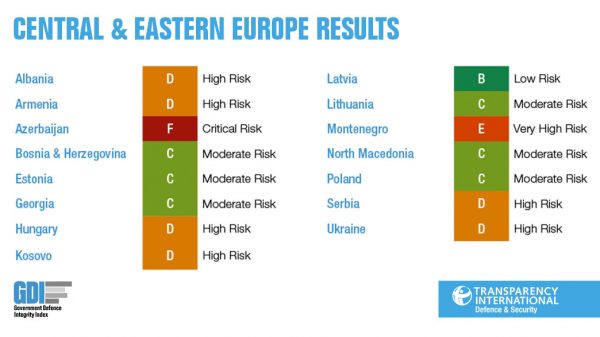
We identify five key themes that are increasing corruption risk across the region, including:
Weak parliamentary oversight
Parliamentary oversight of defence is a key pillar in enforcing transparency and accountability but only two of the 15 countries we assessed have retained truly robust parliamentary oversight.
CEE regional average score: 51/100 (Moderate risk)
Best performers: 1) Latvia: 94/100 (Very low risk); 2) Lithuania: 83/100 (Very low risk)
Worst performers: 1) Azerbaijan 12/100 (Critical risk); 2) Hungary 27/100 (Very high risk)
Opaque procurement processes
Allowing companies to bid for defence contracts helps reduce the opportunities for corruption and ensure best value for taxpayers, but our analysis highlights that open competition in this area is still the exception rather than the norm.
CEE regional average score: 47/100 (High risk)
Best performers: 1) North Macedonia 82/100 (Low risk); 2) Estonia: 74/100 (Low risk)
Worst performers: 1) Azerbaijan 8/100 (Critical risk); 2) Hungary 14/100 (Critical risk)
Attacks on access to information regimes
Access to information is one of the basic principles of good governance, but national security exemptions and over-classification shield large parts of the defence sector from public view.
CEE regional average score: 55/100 (Moderate risk)
Best performers: 1) Georgia, Latvia, North Macedonia, Poland 88/100 (Very low risk); 2) Lithuania: 75/100 (low risk)
Worst performers: 1) Azerbaijan 13/100 (Critical risk); 2) Hungary 25/100 (Very high risk)
To make real progress and strengthen the governance of the defence sector in the region, Transparency International calls on governments across the region to:
- Respect the independence of parliaments and audit institutions and provide them with the information and time they need to perform their crucial oversight role.
- Overhaul their procurement systems to ensure more competition and transparency.
- Guarantee transparent and effective access to information and implement a clear rationale on the use of the national security exception, as well as transparency over how the rationale is applied.
Notes to editors:
Progress [Un]Made – Defence Governance in Central and Eastern Europe can be downloaded here.
The CEE region spent US$104 billion on defence and security in 2019. This total includes Russia, which spent US$65 billion. Lithuania and Latvia increased military spending by 232 per cent and 176 per cent respectively between 2010 and 2019, and Poland by 51 per cent over the same period. Armenia and Azerbaijan consistently spend close to 4% of GDP on defence and are among the most militarised countries in the world.
Whilst defence governance standards in Europe are some of the most robust globally, states in Central and Eastern Europe and the Caucasus, where a combination rising defence budgets and challenges to democratic institutions, are particularly vulnerable to setbacks to their recent progress in governance and development.
In Armenia, Albania, Hungary, Kosovo, Montenegro, Poland and Serbia, there is a notable tendency for parliaments to align themselves with the executive on defence matters, for example by passing executive-sponsored legislation with no or only minor amendments.
In Georgia, secret procurement accounted for 51 per cent of total procurement procedures from 2015-2017. In Ukraine that figure is 45 per cent, while in Poland it is as high as 70 per cent. In Lithuania, open competition accounted for as little as 0.5 per cent of procurement procedures, with upwards of 93 per cent of defence procurement conducted through restricted tenders and negotiated procedures.
In Hungary, the government has made it harder to access information by skewing the rules in favour of public bodies and imposing new fees on those who lodge requests. In Estonia, the 2013 access to information act contained 7 exceptions, with 1 related to defence; by 2018, there were 26 exceptions, with 7 related to defence. Just three of the 15 states we assessed – Lithuania, Latvia and Georgia – were found to have been responding to freedom of requests promptly and mostly in full.
About Transparency International
Through chapters in more than 100 countries, Transparency International has been leading the fight against corruption for the last 27 years.
About the Government Defence Integrity Index
The GDI is the only global assessment of the governance of and corruption risks in defence sectors, based upon 212 indicators in five risk categories: political, financial, personnel, operations and procurement.
The Central and Eastern Europe wave includes assessments for 15 countries: Poland, Hungary, Lithuania, Latvia, Estonia, Ukraine, Armenia, Georgia, Azerbaijan, Serbia, Bosnia & Herzegovina, Kosovo, Albania, Montenegro and North Macedonia. All states are either EU/NATO members or accession/partner states.
The GDI was previously known as the Government Defence Anti-Corruption Index (GI). The Index underwent a major update for the 2020 version, including changes to the methodology and scoring underpinning the project. This means overall country scores from this 2020 version cannot be accurately compared with country scores from previous iterations of the Index.
Subsequent GDI results will be released in 2021, covering Latin America, G-20 countries, the Asia Pacific region, East and Southern Africa, and NATO+.
Contact:
Harvey Gavin
harvey.gavin@transparency.org.uk
+44 (0)20 3096 7695
+44 (0)79 6456 0340 (out of hours)
This report examines the quality and effectiveness of defence governance across fifteen countries in Central and Eastern Europe: Albania, Armenia, Azerbaijan, Bosnia & Herzegovina, Estonia, Georgia, Hungary, Kosovo, Latvia, Lithuania, Montenegro, North Macedonia, Poland, Serbia and Ukraine. It analyses vulnerabilities to corruption risk and the strength of institutional safeguards against corruption across national defence sectors, drawing on data collected as part of Transparency International Defence & Security’s (TI-DS) Government Defence Integrity Index (GDI).
It is intended to provide governments and policymakers with an analysis of defence governance standards in the region and supply civil society with an evidence base that will facilitate their engagement with defence establishments and support advocacy for reforms that will enhance the transparency, effectiveness and accountability of these institutions.
This report details good practice guidelines and policy implications that are designed to reduce the opportunities for corruption and improve the quality of defence governance in Central and Eastern Europe. It identifies five key issues of defence governance where improvements are urgently needed in order to mitigate corruption risks: parliamentary oversight, defence procurement, transparency and access to information, whistleblowing, and military operations.
By Benedicte Aboul-Nasr, Project Officer, Transparency International – Defence & Security
On October 17, 2019, Lebanese citizens took to the streets in response to a government proposal to tax WhatsApp communications, in what would become known as the “Thawra”, or “Uprising” against widespread corruption and worsening economic conditions. A year after the beginning of the protests, and two months after the explosion in the Port of Beirut killed 191 people, injured over 6,500, and uprooted nearly 300,000, Lebanese citizens still have no clear answers as to why for six years, 2,700 tons of explosive chemicals were stored in hazardous conditions at the heart of Lebanon’s capital. Many suspect that a long history of negligence and corruption, the very factors that pushed people to the streets last year, are at least partly responsible for the devastation that took place on August 4, 2020.
The government response has been uneven and in the aftermath of the explosion authorities were slow to support immediate relief efforts. Instead, when Lebanese protesters took to the streets on August 8 to voice their anger towards a political class that many believe has benefited from Lebanese resources for decades, security forces responded harshly, deploying tear gas and live ammunition against protesters. Two days later, Hassan Diab’s government resigned, noting that corruption in Lebanon is “bigger than the state”. And, on August 13, eight days after the explosion, Parliament voted for a state of emergency, giving defence forces a broader mandate than the one they already had under the general mobilisation adopted to help contain COVID-19. Since then, Prime Minister-designate Mustapha Adib stepped down, within a month of his nomination, having failed to achieve the consensus necessary to form a government. At the time of writing, Lebanon remains in a political impasse, while former Prime Minister Hariri, who had stepped down two weeks into the protests in October 2019, is in the running to replace his successor.
Allegations of government corruption are not isolated incidents, and mismanagement has led to numerous crises and leadership vacuums over the years, which paved the way for the protest movement. Lebanon is now facing one of the most serious financial crises in its history which has crippled the economy. The state has defaulted on debt payments and banks are imposing de facto capital controls on withdrawals while Carnegie’s Middle East Center estimates that close to US$800 million were transferred out of the country within the first three weeks of the protests. The Lira lost 80% of its value over nine months; by July this year and Lebanon became the first country in the region to enter hyperinflation. Even before the COVID-19 crisis hit, the World Bank had estimated that up to 45% of Lebanese citizens would be below the poverty line by the end of 2020. Despite undeniable evidence that the situation was untenable, prior to the explosion, discussions with the IMF had been stalled for months, and Alain Bifani, the finance ministry’s director-general, had resigned over state officials’ unwillingness to acknowledge the scale of the crisis and achieve consensus to identify solutions. The contract for a forensic audit of the Central Bank was only signed in August, and the audit itself did not begin until September.
The international community has offered loans and significant humanitarian aid to support victims and the reconstruction of Beirut. Tellingly, several governments have pledged that they would not disburse aid through the government, and are prioritising non-governmental organisations that have been at the forefront of assessment and reconstruction needs. Aid disbursed through the government, and renewed commitments to unlock funds promised by the CEDRE conference in 2018, are conditional on stringent anti-corruption reforms being adopted and must be accompanied by strict oversight. In this regard, it is crucial that Lebanese civil society and non-profit organisations are granted access to sufficient information to oversee the disbursement of aid and prevent funds from being lost.
As part of the broader powers and responsibilities granted to the Lebanese Armed Forces (LAF) under the state of emergency proclaimed after the explosion, the military has been given the crucial role of coordinating the distribution of humanitarian aid and supporting other public bodies in their reconstruction efforts. In carrying out these roles, and with the additional powers from which they benefit, it is crucial that the LAF ensure the highest standards of integrity and transparency with the Lebanese public. The LAF has benefitted from a high level of trust in the past, and remains one of the most representative branches of government – the institution must ensure that it maintains trust and supports ways forward for the Lebanese, in particular as Lebanese citizens and organisations rebuild.
The coming months will be crucial for Beirut’s reconstruction and to help lift Lebanon out of the crisis it is experiencing. Anti-corruption measures and transparency, not only in the disbursement of aid but also in reform efforts, should be prioritised by the armed forces themselves, and more broadly by an incoming government committed to resolve the financial and political crises Lebanon currently faces as the country seeks international support. The Lebanese Transparency Association (LTA), Transparency International’s national chapter in Lebanon, has been advocating alongside Transparency International – Defence & Security for increased transparency and accountability of the defence sector since 2018. In 2020, LTA continued to emphasise the urgent need for further transparency with constituents, and for the armed forces to implement access to information legislation to allow Lebanese citizens to understand how the body functions. As the LAF maintain responsibility in the aftermath of the explosion, both for aid disbursement and for maintaining security alongside security forces, clear communications and oversight of the defence sector are critical.
The explosion and its aftermath have brought issues that Lebanese citizens were familiar with – and which pushed many to the streets over the last year – to the forefront of Lebanon’s dealings with the international community. Only by tackling the root causes, continuing to push for reform, and beginning to rebuild institutions in which the public can trust, will Lebanon have a chance to become more stable and pave a way out of the crisis. Lebanese politicians have often shown willingness to commit to reforms when dealing with the international community in the past. However; reforms have then stalled due to a lack of consensus, for instance leading to delays in implementing access to information legislation, or in selecting members for the National Anti-Corruption Commission. As the international community aims to support Lebanese citizens and help rebuild Beirut, they should be wary of attempts to divert assistance, and of mismanagement in the disbursement of funds. Instead, any international and national initiatives should support Lebanese citizens’ calls to dismantle the root causes of corruption, for the political class to seriously address the financial crisis, and for concrete and measurable steps for reform and accountability.
Benedicte Aboul-Nasr is Transparency International – Defence & Security’s Project Officer working on Conflict and Insecurity, with a focus on the MENA region. She has a background in international humanitarian law and the protection of civilians, and currently researches links between corruption and situations of crisis and conflict.