
Show Index: gdi
By Stephanie Trapnell, Head of Research, and Michael Ofori-Mensah PhD, Project Manager
How to govern military power presents one of the great global challenges of our age. Powerful, secretive and responsible for the world’s most destructive capabilities, when the governance of defence fails, it fails spectacularly, often leading to conflict and further instability. And yet many national defence sectors lack the basic governance standards of other public sectors. Reform programmes are difficult to steward through to success, but the rewards of doing so can improve military effectiveness and help reconnect armed forces with the societies they serve.
To aid this process, Transparency International has developed the evidence-based Government Defence Integrity Index (GDI). It is the first global analysis of corruption risks and the existence and enforcement of controls to manage that vulnerability in defence and security institutions, highlighting priority areas for improvement.
The 2020 iteration of the GDI focuses on 89 countries, selected based on the following criteria:
- their significant and/or high-profile roles in the global arms trade
- being at risk for political or defence-related instability
- undergoing reforms that were expected to result in changed circumstances for defence integrity.
As such, it has a crucial role to play in driving global defence reform. The GDI is designed to be a tool for governments seeking to improve their integrity protocols and a platform to share best practice with civil society, international organisations, the media and country investors, identifying where they need to push for change in the sector.
Overall, our experience to date shows that where governments have used the GDI as a roadmap for reforms, it can make a strong contribution to bringing about positive changes and mitigate the risks corrupt practices can pose to a state’s legitimacy and ability to respond to threats.
What does the GDI measure?
The GDI measures corruption risk, not levels of corruption per se. It assesses that risk in the entire defence and security sector within a country, which involves evaluating the factors that facilitate corruption, and the dynamics that produce an environment in which corruption can flourish unchecked. It is not concerned with measuring the amount of funds that are lost, identifying corrupt actors, or estimating the perceptions of corruption by the general public.
The index is organised into five key corruption risk areas: political, financial, personnel, operational, and procurement, which are further broken down into 29 specific defence corruption risks.
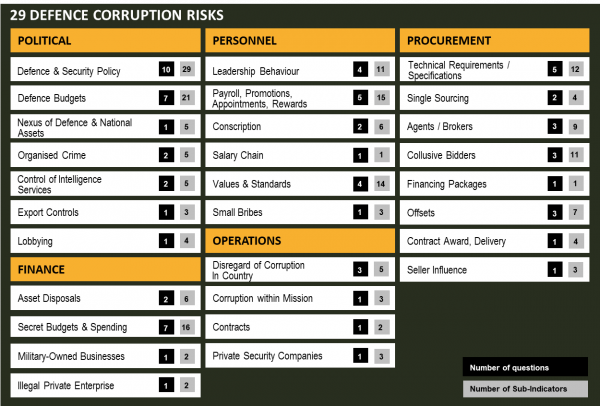
Our team of experts draws together evidence from a wide variety of sources and interviewees across 212 indicators to provide a detailed assessment of the integrity of national defence institutions, and awards a score for each country from A to F. In order to provide a broad and comprehensive reflection of these risk areas, the GDI assesses both legal frameworks (de jure) and implementation (de facto), as well as resources and outcomes. Scorecards, overviews, and profiles for each country can be found here.
What is the overall goal of the GDI?
Good practice standards. The GDI provides a framework of good practice that promotes accountable, transparent, and responsible governance in the defence establishment. This standard of good practice stems from our extensive work over the last decade in working towards more accountable defence sectors and highlighting the connection between corruption and instability.
Evidence-based advocacy. The GDI is a useful tool for civil society to collaborate with Ministries of Defence, and military and oversight institutions to build their capacity in transparency and integrity. It provides rigorous evidence-based data for those focusing on the nexus of corruption and defence.
Robust programmatic approaches. Transparency International – Defence & Security has extensive experience using the index to support reform efforts. This includes: drafting integrity action plans, supporting integrity training workshops, facilitating consultation processes with civil society, and building capacities of parliamentarians to exercise oversight.
Data for countries in West and Central Africa, and the Middle East and North Africa, have recently been released. Subsequent GDI results will be released in 2020, covering Central and Eastern Europe and Latin America, G-20 countries, the Asia Pacific region, East and Southern Africa, and NATO.
Note: The GDI was previously known as the Government Defence Anti-Corruption Index (GI). The Index underwent a major update for the 2020 version, including changes to the methodology and scoring underpinning the project. This means overall country scores from this 2020 version cannot be accurately compared with country scores from previous iterations of the Index. For more information on the GDI methodology, click here.
25 November, London – Security and stability across the Middle East and North Africa continues to be undermined by the risk of corruption in defence institutions, according to new research by Transparency International – Defence & Security.
11 of the 12 Middle East and North Africa states assessed in the 2020 Government Defence Integrity Index released today received E or F grades, indicating either a “very high” or “critical” risk of defence corruption. Only Tunisia performed better, scoring a D.
These findings come against a backdrop of insecurity and fragility in the region. Mass protests – driven by grievances including corruption and financial mismanagement by government – continue in Egypt, Iraq and Lebanon. Meanwhile protracted armed conflicts in Syria, Yemen and Libya show no sign of ending.
Steve Francis OBE, Director of Transparency International – Defence & Security, said:
The Middle East and North Africa remains one of the most conflict-riven regions in the world and this instability has a major impact on international security. While some states have made some improvements in their anti-corruption safeguards, the overall picture is one of stagnation and in some cases regression. Given the empirical link between corruption and insecurity, these results make worrying reading.
Military institutions across the region continue to conduct much of their business under a shroud of secrecy and away from even the most basic public scrutiny or legislative oversight. This lack of accountability fuels mistrust in security services and governments, which in turn feeds instability.
With the regional picture looking bleak, tools like our Government Defence Integrity Index are more important than ever. By highlighting areas where safeguards against corruption are weak or non-existent, campaigners on the ground and reform minded military leaders and politicians can use these results to push for real change. Taking action to improve transparency and close loopholes which allow corruption to thrive would improve public trust and bolster national security.
Defence sectors across the region continue to suffer from excessive secrecy, and a lack of oversight and transparency, the research found. Meanwhile, defence spending in the region continues to surge to record levels.
The countries with defence sectors at a ‘critical’ risk of corruption are Algeria, Egypt, Jordan, Morocco, Oman, Qatar and Saudi Arabia, as there is virtually no accountability or transparency of defence and security institutions. Many of these countries are either major arms importers or benefit from significant international military aid.
In Lebanon, a lack of clear independent auditing mechanisms and gaps between anti-corruption laws adopted in the last two years and their implementation contributed to the country’s “very high” risk status, despite the Lebanese Armed Forces demonstrating high levels of integrity and a willingness to remain neutral and avoid using excessive against protesters.
Tunisia was the only country in the region to rank higher, with new whistleblower protections, improved oversight and public commitments to promoting integrity in the armed forces contributing to its score. But the continued use of counter-terrorism justifications combined with an ingrained culture of secrecy within the defence sector prevented Tunisia from scoring higher.
| Country | Risk banding |
| Tunisia | High risk |
| Lebanon | Very high risk |
| Palestine | |
| Kuwait | |
| UAE | |
| Algeria | Critical risk |
| Egypt | |
| Jordan | |
| Morocco | |
| Oman | |
| Qatar | |
| Saudi Arabia |
Notes to editors:
The full, country-specific Government Defence Integrity Index (GDI) results for the Middle East and North Africa will be available here
The GDI assesses the existence, effectiveness and enforcement of institutional and informal controls to manage the risk of corruption in defence and security institutions.
Our team of experts draws together evidence from a wide variety of sources and interviewees across 77 indicators to provide a detailed assessment of the integrity of national defence institutions, and awards a score for each country from A to F.
The GDI was previously known as the Government Defence Anti-Corruption Index (GI). The Index underwent a major update for the 2020 version, including changes to the methodology and scoring underpinning the project. This means overall country scores from this 2020 version cannot be accurately compared with country scores from previous iterations of the Index.
Subsequent GDI results will be released in 2020, covering Central and Eastern Europe and Latin America, G-20 countries, the Asia Pacific region, East and Southern Africa, and NATO+.
Contact:
Harvey Gavin
Harvey.gavin@transparency.org.uk
+44 (0)20 3096 7695
++44 (0)79 6456 0340
Mallary Gelb
mallary.gelb@transparency.org.uk
+44 (0)20 3096 7695
++44 (0)79 6456 0340
Corruption is widely recognized as one of the fundamental drivers of conflict in Mali. A lack of accountability to the population and a failure to address internal patronage networks has fed into two coup d’états, human rights abuses and the permissive environment for transnational trafficking and organized criminal activity that has fuelled regional conflict. In the meantime, by reducing the operational effectiveness of the Malian armed forces, corruption undermines the state’s ability to field a defence and security apparatus that can guarantee the population protection from insurgent groups, armed violence, or the resurgence of civil war.
Whilst the lack of safety and insecurity linked to conflict is one of the top five most important problems reported by Malians across the country, weak governance in the defence and security sector has hugely corroded public confidence in the government and state security institutions.
This mistrust has been exacerbated by a high level of secrecy and a lack of transparency in the defence sector that have meant that the otherwise vibrant Malian civil society has been unable to provide robust oversight over defence policies, or play a role in combating defence corruption. Civil society in turn has limited capacity to oversee the sector’s activities and requires increased expertise on defence governance and accountability to develop well-evidenced and holistic reform recommendations. At the same time, it lacks opportunities to engage with officials at the level required to catalyze reforms within state institutions. This has given the Malian army the freedom to act largely unmonitored in the North and other insecure areas at a time when the country’s security and integrity is challenged on a daily basis.
Building on our expertise as well as on inputs from Malian civil society organisations from across the country, this report will provide best practice guidelines and recommendations which are designed to diminish the space for corruption and to improve the governance and institutional strength of Mali’s defence sector.
The French Translation of this report can be downloaded here.
October 24, Bamako – Mali’s defence sector has undergone a comprehensive health check in new research from Transparency International – Defence and Security (TI-DS), which stresses the need for urgent action to tackle corruption in order to enable the military to better respond to Mali’s numerous security threats.
Building Integrity in Mali’s Defence and Security Sector assesses the strength of institutional safeguards to corruption in the Malian defence sector and highlights weaknesses in key institutions which have created an environment in which corrupt practices have been able to thrive.
As part of TI-DS’ work to promote integrity in defence sectors across West Africa, this report is designed as an advocacy tool for Malian civil society organisations and campaign groups.
By highlighting the drivers and enablers of corruption and providing tailored recommendations and guidelines, TI-DS offers a roadmap to improved governance and a more accountable military.
Steve Francis OBE, Director of Transparency International – Defence and Security, said:
“Corruption and conflict go hand in hand and their coexistence feeds violence and insecurity. Nowhere is this vicious cycle more evident than in Mali where a lack of integrity and accountability has fuelled two coup d’états and weakened the security forces further.“
“In order to tackle the current security crisis, and to protect the population from future threats, the corruption undermining public trust in the military and reducing its operational effectiveness must be weeded out. We urge the Malian authorities to consider adopting and implementing these policy proposals to help reduce and even eliminate some of the primary enablers of corruption in the defence and security sector. The prize for doing so a military force that the people of Mali want and deserve.”
Key recommendations include:
· Greater oversight of defence purchases and finances. Mali’s defence institutions would benefit from greater oversight and controls over defence purchases and finances. This would enable the efficient use of precious resources and ensure that the Malian defence and security forces are provided with the right equipment to respond to the country’s security threats.
· Harness the powers of the National Assembly. Although the Malian Constitution provides the National Assembly with adequate powers to scrutinise the actions of the executive, it needs further means and the expertise to perform proper oversight over defence. Moreover, access to information remains limited as the overclassification of information curtails its capacities to monitor defence activities and scrutinise budgets.
· Strengthen the integrity of the sector. Mali’s defence establishment suffers from a lack of accountability and transparency in human resource and asset management which has negatively impacted the integrity of the defence apparatus. More transparent, objective and clearly defined human resource and asset management processes will help professionalise and improve the effectiveness and integrity of the armed forces.
This research comes at a crucial time for Mali. Since the near-collapse of the Malian military in 2012, government troops have been battling jihadist militants in the north of the country.
This continued insurgency has prompted local militias to take measures to protect their own interests, further complicating the security situation for the government and exacerbating the suffering of Mali’s citizens.
Note to Editors:
Building Integrity in Mali’s Defence and Security Sector is being officially launched today, October 24, in Bamako.
Contact:
Harvey Gavin
Harvey.gavin@transparency.org.uk
+44 (0)20 3096 7695
++44 (0)79 6456 0340
Transparency International is the civil society organisation leading the fight against corruption
Ghana is often seen as the good governance frontrunner in West Africa. The country is also a strong contributor to international peacekeeping missions, particularly in sub-Saharan Africa, and the Accra-based Ghana Armed Forces Staff and Command College (GAFCSC) and Kofi Annan International Peacekeeping Training College (KAIPTC) are respected training hubs hosting military personnel from across the region.
However, the Government Defence Integrity Index (GDI) 2020 for Ghana highlighted key areas of continued corruption risk within the defence sector, including a lack of transparency in procurement, limited oversight over key defence issues, and limited acknowledgement of corruption as a strategic issue on military operations.
Our project, which began in March 2019 and is funded by the UK Department for International Development, aims to work with national Ghanaian defence institutions, civil society and media organisations, and parliamentarians to strengthen their anti-corruption expertise and their capacity to implement effective change. Key project activities include conducting Leadership Days for senior defence officials to introduce them to corruption risks and best practice; supporting national civil society and media in engaging in coordinated advocacy activities; conducting capacity-building workshops for parliamentarians responsible for defence oversight; and working with KAIPTC and GAFCSC to strengthen anti-corruption training for military personnel.
In strengthening the expertise and capacity of Ghanaian institutions, Transparency International – Defence & Security and the Ghana Integrity Initiative aim to support the country’s efforts in becoming a regional lead on defence anti-corruption issues and improving the integrity of their international peacebuilding activities.
Corruption is widely recognized as one of the fundamental drivers of conflict in Mali and a lack of accountability to the population from the defence and security apparatus has fed into the unrest. With the support of the UNDEF, and in partnership with Transparency International’s National Chapter in Mali CRI-2002, we are seeking to reduce the risk of corruption in the Malian defence sector, through strengthening civil society’s expertise on defence accountability and good governance and building its capacity to influence anti-corruption reforms in the sector.
In many countries, there is a critical disconnect and lack of communication and understanding between civil society and defence and security institutions which results in very limited interaction and engagement. This hinders the effectiveness and accountability of defence institutions and restricts civilian understanding and knowledge of the sector which can lead to a shortfall in trust between the two.
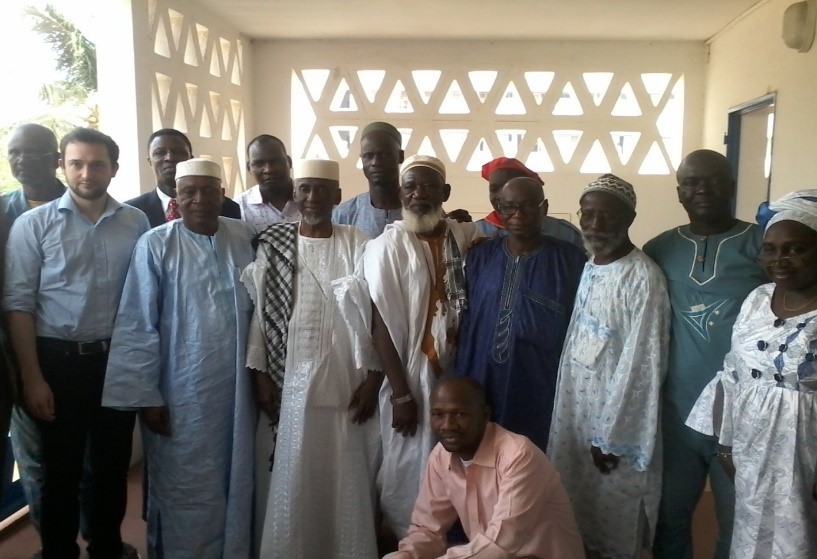
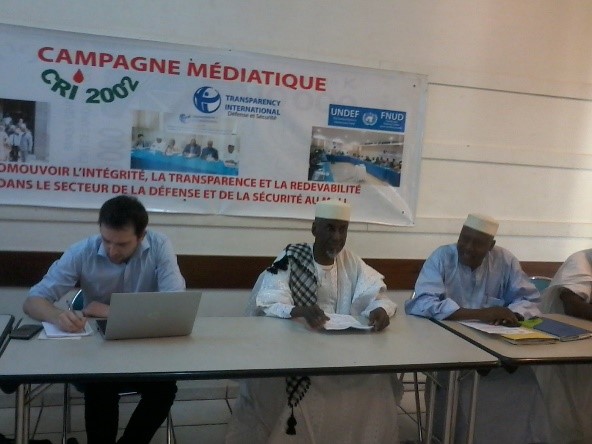
We have conducted detailed research into institutional safeguards in Malian defence institutions and held a series of regional focus group discussions to form a solid evidence base to help build the capability and coordination of civil society advocacy efforts for greater defence accountability. The creation of a national Civil Society Organisations (CSO) Forum specialised on defence and security issues, made up of 30 Malian CSOs with its own structure and strategy has helped to coordinate civil society efforts and establish a credible platform with which to engage with the defence sector. We have also worked to build relationships with key government agencies in Mali and organised leadership days, bringing together senior defence officials with civil society actors to bridge the gap between the two and foster consensus on necessary reforms. This approach has been complemented by an ongoing media campaign which is raising awareness as to the detrimental effects of defence sector corruption among the wider Malian population.
TI-DS in Mali
 |
 |
Corruption had an undeniable impact on Nigeria’s security situation. Corruption in the defence sector, in particular, has resulted in the waste of billions of dollars’ worth of public funds through corrupt defence procurement practices and the abuse of the opaque security funding system known as “security votes”. This public money could have been otherwise more productively directed towards countering security threats and building a modern and efficient defence force. Corruption within the Nigeria defence sector arguably inhibited the ability of Nigerian armed forces to effectively tackle the insurgent threat in the North East as well as respond to the oil bunkering in the Niger Delta, the conflict in the Middle Belt and the threat of maritime piracy in the Gulf of Guinea – reports of ghost soldiers, the skimming of soldiers’ salaries, and the procurement of faulty and outdated weaponry suggest misconduct within the armed forces that affected operational effectiveness.
In cooperation with our local chapter in Nigeria, the Civil Society Legislative Advocacy Centre (CISLAC), we are conducting a project aiming to Increase Transparency, Accountability and Integrity in the Nigerian Defence Sector (ITAI). ITAI’s objectives focus firstly on building a culture of integrity within Nigeria’s armed forces and civilian defence structures by working to develop an understanding of anti-corruption as crucial to achieving stability, and by supporting internal anti-corruption efforts.
Secondly, ITAI aims to strengthen civilian efforts to conduct effective oversight over the defence sector. We are therefore working with parliamentarians responsible for overseeing defence, civil society organisations and media representatives. Our aim is to not only strengthen these actors’ capacity and expertise on defence oversight but to also work with them to generate a strong and informed public discourse on defence corruption risks in Nigeria.
Our ITAI project builds on existing work conducted by Transparency International – Defence & Security and CISLAC in Nigeria through a previous project entitled Strengthening Accountability in the Nigerian Defence Sector (SANDS).
Lebanon has avoided the spill over from the conflict in Syria, but currently faces rising regional tensions which some fear could lead to conflict in Lebanon. At the same time, military expenditure has risen to 5% of the country’s share of GDP, and close to 14% of government spending; one of the highest shares of the government’s spending. While the Lebanese Armed Forces (LAF) benefit from support which generally transcends sectarian lines, the institution faces high risks of corruption due to limited parliamentary oversight and access to information, amplified by the lack of transparency to citizens and accountability beyond the armed forces. Strengthening the integrity of Lebanese defence institutions is crucial to guaranteeing an armed forces that can effectively respond to threats and is accountable to the Lebanese people.
Lebanon’s security situation remains fragile, and corruption a systemic weakness. The LAF have been keen to engage, and exhibit some regional best practices. Transparency International strives to capitalise on these best practices and the ongoing movement towards reform to encourage strengthening integrity within the armed forces.
We have therefore been working in partnership with the Lebanese Transparency Association (LTA), Transparency International’s chapter in Lebanon, since 2018. The primary aim of our Lebanon country programme is to promote transparency and the enhancement of integrity mechanisms within the Lebanese Armed Forces (LAF). Our approach is to collaborate, pursue dialogue, and engage with the LAF, as the Lebanese government seeks to demonstrate its broader commitment to reform and to countering corruption.
We are refining plans to achieve policy and institutional changes following the launch of the Government Defence Integrity Index (GDI), including strengthening anti-corruption reforms and promoting transparency and accountability within the LAF. Alongside this, we will collaborate to build the capacity of civil society to engage with the government, military and international community on defence corruption issues. We believe that raising stakeholder capacity is crucial to tangible progress within Lebanese defence institutions and, in turn, to strengthen the government’s ability to respond to its own national security threats.
Relevant publications
 |
 |
Military expenditure in Tunisia has increased to over 2% of the country’s GDP in recent years as counter-terrorism has become a government priority. The country has been under a state of emergency since 2015, due to continued conflict in neighbouring states and increased support for non-state armed actors and extremist groups. Despite this, Tunisia’s defence sector faces high corruption risks, largely due to its secretive nature and the difficulties for Tunisian citizens to access information on military spending and equipment. While the armed forces benefit from a high level of public trust and have made several commitments to strengthen integrity within the defence system, implementation of these commitments has, to date, been uneven. Moving forward on defence sector reforms would improve the military’s ability to respond to potential threats.
Strengthening governmental institutions, including through transparency and accountability to citizens, is also crucial in a nascent democracy such as Tunisia, to ensure that the government is capable of responding to the population’s needs. As part of this, Transparency International established a project in 2018 to advocate for the Ministry of Defence to strengthen access to information and accountability to Tunisian citizens.
We have been working in partnership with I WATCH, Transparency International’s chapter in Tunisia, since 2017. The primary aim of our Tunisia country programme is to promote improved transparency and encourage tangible reform within the Tunisian defence sector, by bolstering the capacity of civil society and supporting democratic civilian oversight of the sector. Transparency International – Defence & Security and I WATCH are keen to engage with the Ministry of Defence throughout the development of the Government Defence Integrity Index, all the while strengthening external oversight of the defence sector and raising civil society awareness of the importance of defence sector oversight.
In order to achieve these aims, we established an independent monitoring group comprised of Tunisian civil society and experts within the defence and security sectors in 2019 alongside I WATCH. The purpose of this group is to monitor the Tunisian defence sector’s progress in implementing reforms and improving transparency and accountability to Tunisian citizens. The group held its inaugural meeting in September 2019, where it identified its top priority issue areas to tackle in the coming year and developed an agenda for producing research and evidence-based advocacy.
The Niger Delta is the most important oil-producing region in Africa, with its oil providing 70 per cent of Nigeria’s government revenue. However, alongside the legitimate trade in the Delta’s oil products, there is a lucrative and organised illicit oil trade that reportedly loses Nigeria 200,000 barrels of oil every day. Participants in oil theft, also called “oil bunkering”, steal oil from pipelines, refine the oil, and then sell it to local, regional and international markets. It is a profitable criminal industry that cost the Nigerian government 3.8 trillion Nigerian naira (approx. USD$105 billion) in 2016 and 2017.
The illegal oil industry in the Niger Delta has received much international attention over the past few decades. Illegal activity has led to revenue losses as oil is siphoned off and stolen; the human cost and environmental pollution have similarly been significant. Regular spills of oil, arguably caused by oil theft and sabotage, have polluted the waterways, contaminated crops and other food sources, and released toxic chemicals into the air. In 2017, reports emerged that oil spills doubled the risk of child mortality in the Delta region.4 What remains under-explored, however, is the extent to which this illegal trade is enabled by one of Nigeria’s key state institutions: its armed forces.
This discussion paper presents preliminary findings based on interviews and focus group discussions conducted in the Niger Delta between February and July 2018. The goal is to understand how the situation evolved, to offer insight into our initial conclusions, to invite feedback and further consideration of the matter, and to provide guidance for further research.
Following several years of debate, Tunisia finally has strong legislation regarding access to information. The government adopted a law to this effect in 2016, praised by many as being one of the most progressive access to information laws in the world. However, the law has faced limitations to its application, which include overzealous application of national security related exceptions.
Transparency International Defence & Security and I WATCH (Transparency International’s national chapter in Tunisia) have conducted research to understand how the access to information law is being implemented in the defence sector. We have spoken with Members of Parliament, independent commissions and civil society organisations (CSO) in Tunisia, and conducted desk research. Additionally, I WATCH has filed several access to information requests to the MOD directly, to evaluate the nature of responses received. These activities have provided the findings, and formed the basis of our conclusions and recommendations, outlined below.
A translation of the report can also be read in Arabic here.
Ahead of the 2019 Presidential elections in Nigeria, Transparency International and the Civil Society Legislative Advocacy Center (CISLAC) are calling on candidates to commit to scrapping the unaccountable and secretive “security vote” spending – one of the most durable forms of corruption in Nigeria—saying that they fail to provide real security for citizens.
Read the full report below and download ‘Annex A: Federal Security Vote Data’ here and ‘Annex B: State Security Vote Data’ here.