

By Emily Wegener, Senior Policy Officer, Transparency International Defence & Security
Last Wednesday, Russia’s full-scale invasion of Ukraine entered its fifth year. Over the past four years, Europe has been forced to confront the reality that war on its continent is not a thing of the past, and that it cannot rely on others to provide for its security. At Chatham House’s annual Security and Defence Conference last week, the mood reflected a sector entering a new era: technical and financial changes are beginning to bear fruit, and the mourning period for pre-2022 assumptions is over.
But one concern loomed largely in the room: public support. Leaders are waking up to the fact that record levels of defence spending is arriving at the worst possible time for public trust in institutions. Across OECD countries, a higher share of people (44%) report low to no trust in their national governments than moderate to high trust (39%). The question is no longer just whether the public understands the threat. It is whether the public trusts governments to respond to it competently.
This is a crucial distinction. Much of the discussion at Chatham House focused on better communicating the severity of the threats Europe faces. That matters. But it misses a deeper problem. The evidence suggests the public is not suffering from a knowledge gap – it is suffering from a trust gap. And that demands a fundamentally different response.
Support is broad but shallow – and already declining
Opinion polls from the last six months offer European leaders some comfort: majorities across the EU and also in the UK support defence spending increases. But the picture is more fragile than it first appears. Support levels are already declining from their post-invasion peak. When broken down by degree, only around one-third of respondents back strong spending increases- and there are sharp regional variations (see figure 1), closely tied to how directly different populations perceive the threat from Russia (see figure 2).
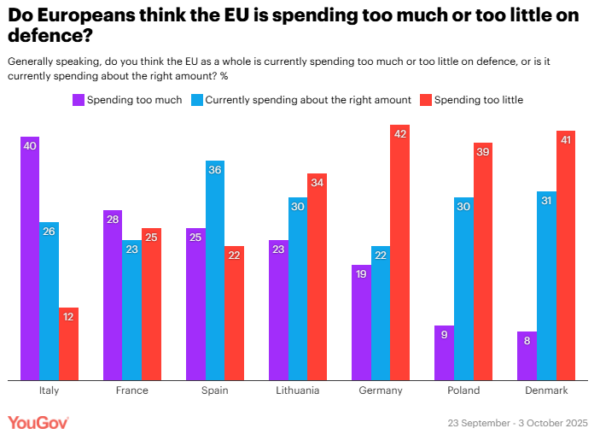
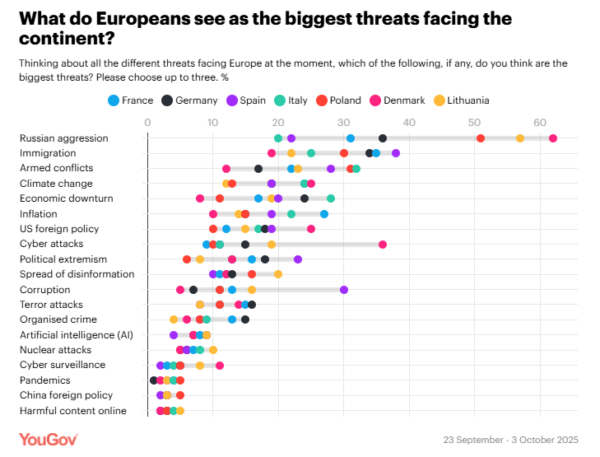
With support levels already past their peak, it is the future of public buy-in that leaders at Chatham House rightly expressed great concern about. Trade-offs between military and social spending – which, in time of tight budgets, seem inevitable if NATO’s 5% spending commitment is to become reality – are unsurprisingly unpopular: for example, polling from the UK shows that only 29% would support cuts in social security spending to fund military spending, and only 34% cuts on climate action.
The (risky) promise of growth will not fix the trust gap
Many leaders are trying to soften these trade-offs by positioning defence spending as catalyst for economic growth. The problem is that the evidence does not support this. Defence ranks among the least effective forms of government expenditure for driving economic growth. And the public knows that: a large majority of European citizens do not expect to benefit from higher defence spending – a scepticism that increases with financial literacy.
The problem is not a knowledge gap. The problem is that the argument does not hold and could become a risky gamble with an already feeble public trust. Leaders would be better served by honesty about costs and a credible case for responsible governance.
Democracy is not dead – but voters wish for better governance
The roots of the trust deficit run deep. Across and beyond Europe, citizens are increasingly less confident in their institutions and highly dissatisfied with how democracies are working. Amongst headlines such as “1 in 5 Europeans say dictatorship might be preferable”, how does this impact support for defence spending?
Corruption is perceived by many Europeans as one of the biggest threats to the continent – ranking above terror attacks (see figure 2) – and its democracies. Countries that are more worried about corruption and lacking accountability in politics, such as Spain, Italy, and France, also often rank amongst those more sceptical towards defence spending increases. Of course, factors such as geographical proximity to Russia and history of Russian occupation are likely to be stronger determinants in shaping these views.
But if governments want citizens to support them in significant investment in a sector that is notoriously remote and secretive, they will need to have confidence that institutions will use these resources effectively and responsibly. Evidence shows that the inability of governments to respond to recent crises, such as the corruption-fraught pandemic response and the cost-of-living crisis, have contributed greatly to recent declines in trust.
A problem and an opportunity
Citizens want their states to do better. Strengthening transparency, anti-corruption and accountability is a prime way to restore trust. A recent IPSOS study across eight European countries and the US found that “[s]trong desire for radical change coexists with continuing support for democratic principles”. Stronger anti-corruption laws and enforcement were seen as the most effective out of all potential solutions to strengthen trust in democracies in 7 out of the 9 surveyed countries (Croatia (78%), Spain (76%), Poland (63%), US (55%), UK (51%), Italy (49%), Sweden (47%)).
Embedding integrity into transforming defence architectures across EU and NATO countries provides an opportunity to act on these demands. Over recent weeks, Transparency International Defence and Security has laid out a vision for how this can be done, with clear recommendations for embedding transparency, accountability, anti-corruption and oversight firmly in European defence (see here, here and here). If leaders want to keep the public on board its defence spending plans, they need to demonstrate that they have learnt from mistakes of the past, and are taking their citizens’ demands for better governance seriously.
For a sector traditionally closed-off, from public scrutiny, this will also mean engaging with civil society in a new way: inviting civil society groups to stakeholder conversations, consulting their views, and engaging in dialogue with broader parts of the population. Strong lessons can be learned here from Ukraine, where civil society has helped the defence sector become more effective, less corrupt and more trustworthy.
Close the trust gap or lose the public
The discussions at Chatham House last week showed: leaders are aware that sustainment and success of their ambitious defence agendas will rest on their ability to bring the public with them. Record investments in defence, at a time with tight budgets, are unlikely to receive sustained public support if European citizens cannot trust their governments to translate these resources into strengthened security outcomes.
We have showed how this will not only require bridging a knowledge gap – it will require bridging a trust gap, too. Strengthening integrity in the defence sector is a key way to respond to the public’s demand for more effective governance and demonstrate that states have learnt from failed crisis responses of the past.